
Appen accepts Indian workers, but you now sign up at crowdgen.com rather than the old Appen Connect address. Rates are set per project and per country, and Indian contributors most often report $2 to $7 an hour, not the $10 to $20 that reviews written for a US audience quote. The catch is availability, not eligibility.
Listen to this article, about 9 minutes. A synthetic voice reads the article and announces each section title as it begins; tables are read row by row and the questions at the end are left out.
Recorded 10 October 2026 from the article as published that day. Press a chapter to jump there; the highlighted line is what is playing. A play button sits beside every section heading, and once you scroll past this player a bar at the bottom of the screen keeps the controls in reach. Tap or click any sentence to hear the reading start from there.
On this page: a comparison of reported hourly rates in India, a strategic setup checklist, and a comparison table of alternative platforms.
Think you already know this? Five questions, one minute.
Every answer is on this page. Answer from what you know now; the page fills in the rest.
-
1. Which website is the correct place to sign up for Appen tasks now?
You must start at crowdgen.com because the old Appen Connect address is no longer used. Read the section
-
2. What is the reported hourly pay range for search engine evaluation in India?
While US reviews quote higher rates, contributors in India report earning between 3 and 7 dollars per hour for search engine evaluation. Read the section
-
3. By which day of the month does CrowdGen state that payments are credited?
According to official documentation, payments are credited by the 14th of each month, covering the previous month’s earnings. Read the section
-
4. Who acquired Clickworker in December 2024, causing its branding to shift?
Clickworker has been owned by LXT since the acquisition announced in December 2024. Read the section
-
5. What is one reason why the Appen project pipeline has thinned out recently?
The pipeline thinned because some simpler labelling work is now done by models rather than people, and remaining work has moved toward specialist queues. Read the section
Appen is the platform people most often recommend from memory. It deserves a more current look than that, because the sign up address, the pay you can expect from India and the way you get paid have all changed.
Where to actually sign up
Start at crowdgen.com. This trips people up constantly, because a great many guides still point at Appen Connect, which is what CrowdGen used to be called. If you land somewhere asking for money, you are on the wrong site entirely.
You will build a profile covering your languages, location, skills and the devices you have access to. Be precise here. Project matching runs off this profile, and vague entries get you matched to nothing.
What does Appen actually pay in India?
| Type of work | Quoted in US and UK reviews | Reported from India | Availability |
|---|---|---|---|
| Basic annotation and evaluation | $5 to $12 per hour | $2 to $5 per hour | Inconsistent |
| Search engine evaluation | $12 to $18 per hour | $3 to $7 per hour | Most consistently available |
| Content moderation | $12 to $20 per hour | Varies sharply by project | Moderate |
| Linguistic and translation work | $15 to $25 per hour | The best paid queue open to India | Depends on your languages |
Those two columns are the whole story, and almost no review prints both. Appen prices a project against the country it is recruiting in rather than paying one global hourly wage. So a search evaluation queue paying $15 an hour in the United States is a genuinely different queue from the one open to you in Pune, even where the task on screen looks identical.
Be careful with all of these figures, including ours. Appen publishes no rate card. The India column is assembled from what contributors report rather than from anything the company states, and individual accounts run from about $2 an hour up to low double digits on a good specialist queue. Treat the ranges as the shape of the thing, not a quote.
Search evaluation is still the sweet spot in relative terms. It is the most widely available Appen work, it pays near the top of the queues you can actually reach, and Indian English is an asset rather than an obstacle for a good share of it.

The honest problem: the pipeline has thinned
This is the part that a review written in 2022 will not tell you. Workers consistently report long waits between projects, sudden cancellations partway through, and simply less work than there used to be. The platform that once had more tasks than people now has stretches where the pipeline runs dry. For how many paid hours a week are realistic across Appen, Outlier, Mindrift and TELUS, see our breakdown of realistic AI training hours in India.
Search evaluation and social media assessment remain relatively steady. Everything else comes and goes. If you sign up expecting a reliable weekly income, you will be disappointed, and that disappointment is a property of the platform rather than a mistake you made.
Payment: the slow part
Appen pays monthly, and the schedule is more specific than that. CrowdGen states that payments are credited by the 14th of each month, covering the previous month’s earnings, with reconciliation finished at the end of the first week. Work done on 2 September is therefore money in your account around 14 October, which is roughly six weeks on the earliest task of the month.
The payout options have widened since most guides were written, which is the good news in this section. It is no longer PayPal or Payoneer and nothing else. CrowdGen now routes payouts through a provider called Dots and offers local bank transfer, PayPal, Payoneer and Airtm among others, with the exact menu depending on your country. Local bank transfer into an Indian account is the option worth checking first, because it sidesteps the conversion spread that makes PayPal expensive.
Monthly is still genuinely slow when Outlier and Clickworker both pay weekly, and it matters more than it sounds when you are starting out and want to see that the thing actually works.
Whichever platform you end up on, the payment rail you choose affects your take home more than most people realise. On a $1,000 payment the gap between the cheapest and most expensive option is over $50. Our guides on getting paid from abroad work through the actual numbers.

Toh Appen worth hai ya nahi?
Worth applying to. Not worth relying on.
The pattern in every honest 2026 account is the same: people who treat Appen as one platform among several do reasonably well out of it. People who treat it as their income get frustrated within a month. Sign up, pass what you can, take search evaluation work when it appears, and keep applications live elsewhere. Start with which platforms actually accept India, and read what Outlier really pays in India before you decide where the first week of effort goes.
Appen vs the alternatives, briefly
- Outlier pays better at the top end and pays weekly, but its assessments are harder.
- Clickworker is easier to get into and also pays weekly, though typically less per task. It has been owned by LXT since the acquisition announced in December 2024, which is why the branding keeps shifting, and our Clickworker review for India covers what that changed for workers.
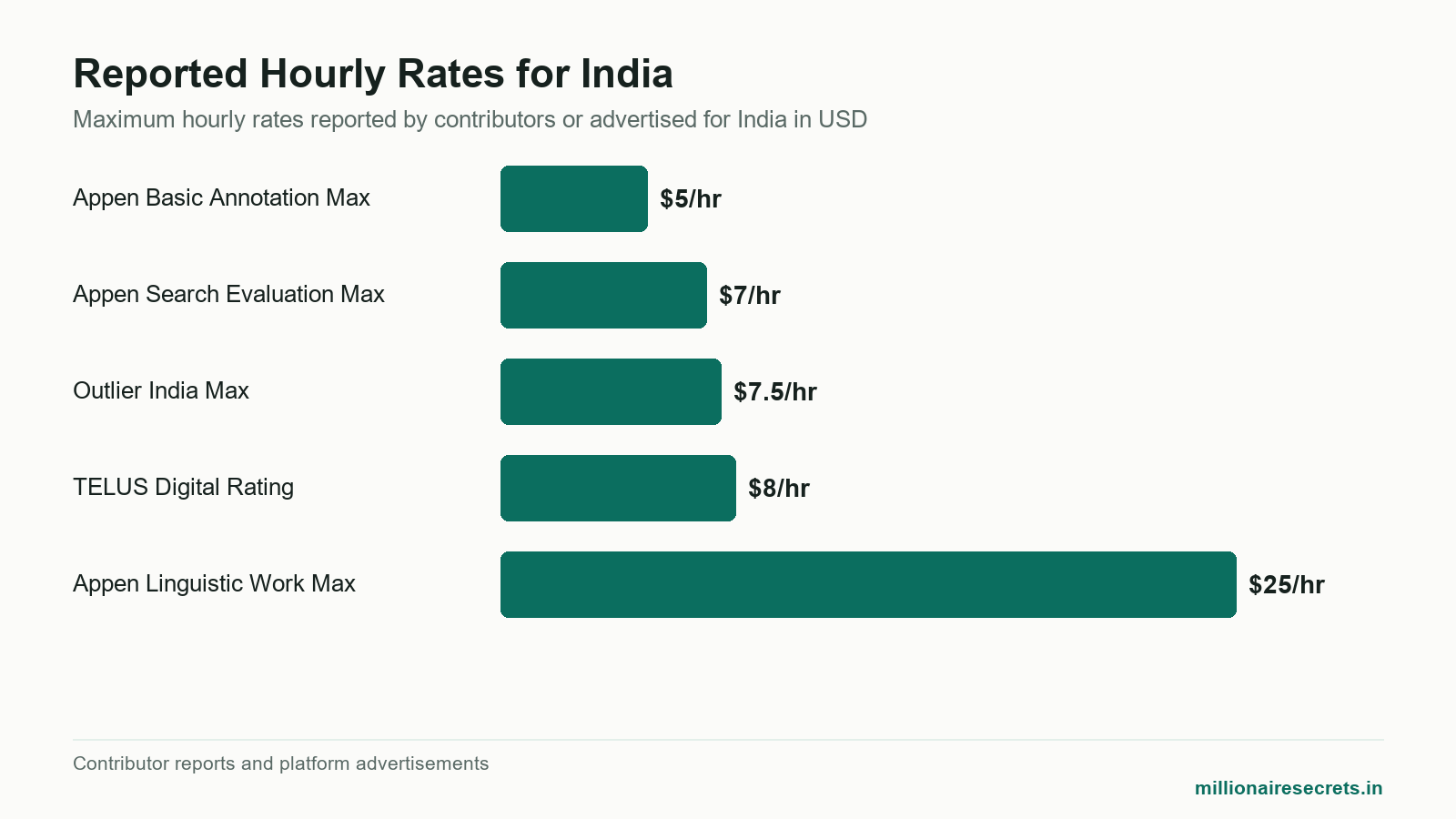
- TELUS Digital runs India specific rating roles at around $8 an hour with a clearer application path.
- DataAnnotation is not an option, because DataAnnotation does not accept India.
Why did the Appen pipeline thin out?
Worth understanding, because it tells you how to use the platform rather than just warning you off it.
Appen built its business on a large, general crowd doing search evaluation and data labelling at scale. That model has been squeezed from two directions. Some of the simpler labelling work is now done by models rather than people, and the work that remains has moved toward specialist queues where the buyer wants proven subject knowledge rather than a large general pool.
The result is a platform that still has real work, still pays, and still accepts Indians, but no longer offers the steady general stream it once did. Reviews written before this shift describe a different platform to the one you will sign up for.
The same squeeze explains where the money went rather than simply vanished. Demand moved up the ladder, toward platforms paying for proven expertise instead of a general crowd, which is the shift we traced in Mercor, Alignerr and Handshake AI. It also explains the other direction of travel, where a once busy general platform quietly stops recruiting, which is what happened to Remotasks in India. Appen sits between the two: open, but thinner than it was.
So how should you actually use Appen?
- Treat it as a second or third platform, never your first. The waiting is real and you need income arriving from elsewhere while you wait.
- Target search evaluation specifically. It is the most consistently available work and pays near the top of the common queues at roughly $14 to $18 an hour. Correction, 23 September 2026: that band is drawn from specialist and non India queues, and Outlier’s own India facing pages advertise up to $7.50 an hour, which our comparison of Appen vs Clickworker vs TELUS vs Outlier sets out row by row.
- Fill your profile out precisely. Matching runs off it. Vague profiles get matched to nothing, and this is the most common self inflicted problem.
- List every Indian language you speak. Linguistic work reaches $25 an hour and native speakers are scarce.
- Accept the monthly payment cycle or do not sign up. It is slow next to weekly payers and that will not change.
The honest summary: Appen is worth an application and is not worth an expectation. Sign up, keep the profile current, take search evaluation work when it appears, and let it be the platform that occasionally surprises you rather than the one you are counting on.
Appen India Strategy Checklist
Follow these steps to maximize your chances of securing paid tasks on Appen while managing your expectations.
Ticks are saved on this device only.
Related reading
- Which AI training platforms actually accept India
- Outlier AI in India: eligibility, pay and assessments
- Clickworker in India, now part of LXT
- How to receive foreign payments in India
Frequently asked questions
Does Appen still accept workers from India?
Yes. Appen supports more than 200 countries and remains open to Indian applicants. Sign up at crowdgen.com, which is the current home of what used to be Appen Connect.
How much does Appen pay in India?
Less than most reviews claim, because those quote US rates. Appen prices each project against the country it recruits in, and Indian contributors most often report $2 to $7 an hour. Linguistic queues pay best.
Appen se paisa kaise milta hai?
Monthly. CrowdGen credits payments by the 14th of each month for the previous month’s earnings, and now offers local bank transfer, PayPal, Payoneer and Airtm among others. Outlier and Clickworker both pay weekly.
Why is there no work available on my Appen account?
The Appen pipeline has thinned considerably since its peak. Long gaps and sudden project cancellations are widely reported and are not specific to your account.
Is CrowdGen the same as Appen?
Yes. CrowdGen is Appen’s worker platform and is what Appen Connect became. Guides pointing at the old address are out of date.
Is Appen legit or a scam?
Appen is a long established, legitimate company. It does not charge you to join. Anyone asking for a registration or training fee in Appen’s name is not Appen.
Why does Appen have less work than it used to?
Simpler labelling work has increasingly been automated, and remaining demand has shifted toward specialist queues wanting proven subject knowledge rather than a large general crowd. Reviews written before that shift describe a different platform.
What is the best paid work available on Appen?
Linguistic and translation work reaches around $25 an hour and native Indian language speakers are scarce. Search evaluation, at roughly $14 to $18, is the best of the widely available queues.
Finished the page? The same five questions from the top, to see what stuck.
Platform rules and rates change without notice. The pay and payment figures here were rechecked on 6 September 2026 against CrowdGen’s own payment documentation and current contributor reports. Appen publishes no rate card, so the India figures are reported ranges rather than quoted rates. If you hit something different, tell us in the comments and we will update it.

Leave a Reply