
Digital marketing jobs remote from India advertised Rs 2,00,000 to Rs 9,00,000 a year on the 332 Internshala listings we read on 21 October 2026, entry roles at Rs 2 to 3 lakh. Internships paid Rs 3,000 to 6,000 a month. The paid course with a guaranteed job pays worst, and India’s ad rules bar the guarantee.
Listen to this article, about 14 minutes. A synthetic voice reads the article and announces each section title as it begins; tables are read row by row and the questions at the end are left out.
Recorded 21 October 2026 from the article as published that day. Press a chapter to jump there; the highlighted line is what is playing. A play button sits beside every section heading, and once you scroll past this player a bar at the bottom of the screen keeps the controls in reach. Tap or click any sentence to hear the reading start from there.
On this page: five job boards opened on 21 October 2026 with the counts and pay as printed, the ASCI and CCPA rule text on guaranteed job claims, 45 comments and reviews from people who paid for the courses, a checklist built from the rule text, and a calculator that turns a CTC or a dollar rate into a month.
Think you already know this? Five questions, one minute.
Every answer is on this page. Answer from what you know now; the page fills in the rest.
-
1. How many work from home listings did Internshala show for the keyword digital marketing on 21 October 2026?
Internshala’s keyword page printed 332 that morning, with first page pay of Rs 2,00,000 to Rs 9,00,000 a year. The 9,000 plus figure is LinkedIn’s national count, which its remote filter does not change. Read the section
-
2. What typical hourly band does Upwork print for a digital marketer in Noida?
Upwork’s Noida hire page prints $12 to $15 as typical for Noida and $41 to $84 as its US baseline for the same role, read 21 October 2026. Read the section
-
3. Which claim does ASCI clause 4 name as its own example of a barred 100 percent figure?
The ASCI guidelines for educational institutions, clause 4, bar a 100 percent figure on abstract claims and give 100% Placement/Job assistance and 100% Job oriented courses as the examples. Read the section
-
4. Why did WsCube Tech’s Trustpilot page show no TrustScore when this page read it?
The WsCube Tech page carried 64 reviews on 21 October 2026 and a notice that the score was unavailable after a breach of guidelines, with fake reviews removed. That is Trustpilot’s statement, not a finding about the course. Read the section
-
5. How long is Google’s Fundamentals of Digital Marketing course on Skillshop?
The Skillshop course page lists 17 modules, a 40 hour duration and a badge on completion, published by Google, read 21 October 2026. Read the section
What do digital marketing jobs remote from India actually pay today?
Every page ranking for this query carries the same paragraph: fresher Rs 3 to 5 lakh, mid level Rs 6 to 12, senior whatever the writer felt that morning. None of them opens a job board on the day. We did, and the table is what five boards showed on 21 October 2026, counts and pay as printed.
| Board, read 21 October 2026 | What it showed | Pay where stated | What the count hides |
|---|---|---|---|
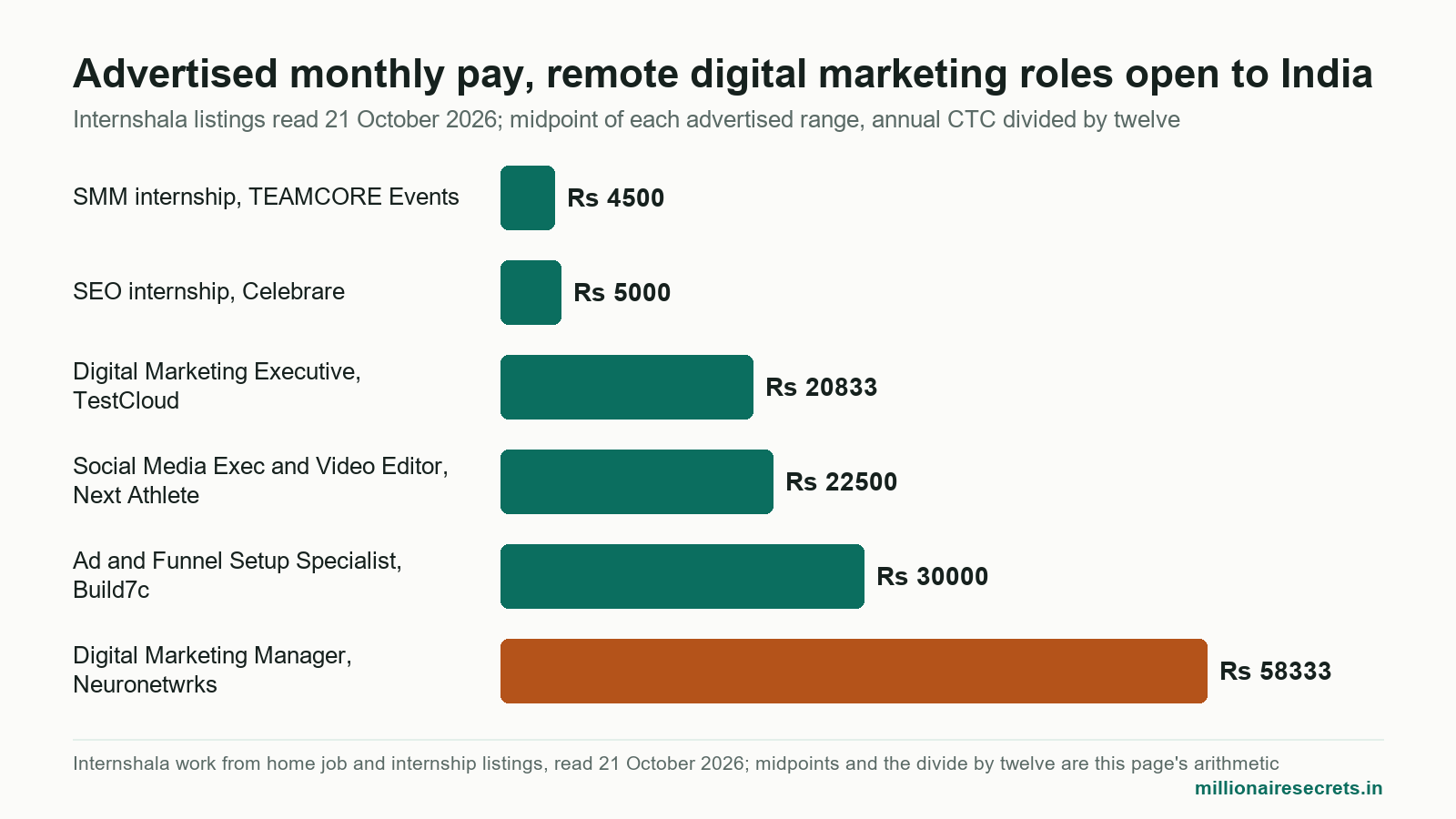
| Internshala jobs | 332 work from home jobs for the keyword, 40 visible on the first page | Rs 2,00,000 to Rs 9,00,000 a year; a Digital Marketing Executive at Rs 2,00,000 to 3,00,000 with no experience asked, an Ad and Funnel Setup Specialist at Rs 2,40,000 to 4,80,000, a Digital Marketing Manager at Rs 5,00,000 to 9,00,000 | The keyword pulls in sales executives, lead generation associates, a content writer and a campus ambassador. Roughly a third of the first page is marketing work by title. |
| Internshala internships | 737 work from home digital marketing internships | Rs 1,000 to Rs 40,000 a month; six of the first 50 unpaid, three “performance based” | Most sit between Rs 3,000 and Rs 6,000 for two to six months. This is paid practice, not a job. |
| “9,000+ Digital Marketing Jobs in India”; the remote filter does not change the printed count | None of the first eight listings showed a salary | All eight named a city. LinkedIn’s India count is a national figure dressed as a remote one. | |
| Remote OK | 2,987 results under its marketing filter, worldwide | Not readable without a login on the day | Worldwide means the employer chooses the country; most of these do not say India. |
| Upwork | Freelance rates, not jobs | Global median $25 an hour, typical $15 to $45; India city pages show $4 to $30 with most profiles at $5 to $10, Noida’s typical band $12 to $15 | Upwork’s own US baseline for the same role is $41 to $84 an hour. The client is paying for the passport, not the skill. |
Two things stand out. The honest remote salaried floor for a fresher is Rs 2,00,000 a year, about Rs 16,700 a month before anything comes off it. And the biggest numbers in the query, the 9,000 plus on LinkedIn and the near 3,000 on Remote OK, are not remote India jobs once you read past the heading. A count is only a count when the filter is applied.

The remote jobs that pay well on the Indian boards are specific: ad and funnel setup, performance marketing, a manager seat at an agency. They ask for one year of experience and say so. The categories that genuinely hire from India have not changed much; what has changed is how many courses now stand between the reader and the listing.
Salaried remote, Indian freelance, or foreign client: which pays what?
Three routes carry the same job title and pay three different amounts, and a dollar figure on a course brochure means nothing until the fee and the exchange rate have had their turn.
| Route | Money in, before tax | Who takes a cut | What it really is |
|---|---|---|---|
| Salaried remote job with an Indian employer | Rs 16,700 to Rs 25,000 a month at the entry CTC of Rs 2,00,000 to 3,00,000; Rs 41,700 to Rs 75,000 at the one manager listing | Nobody, but CTC is not take home: PF and any variable pay come off the printed figure | A job. Fixed hours, one boss, Form 16 at the end of the year. |
| Work from home internship | Rs 3,000 to Rs 6,000 a month in most listings, Rs 40,000 at the top | Nobody | Paid training with a certificate. Judge it as that. |
| Freelance for Indian clients on Upwork | $5 to $10 an hour on most India profiles, about Rs 480 to Rs 960 at roughly Rs 96 to the dollar | Upwork’s service fee of 0 to 15 percent, fixed when you send the proposal | Self employment. No hours are promised and the first month is usually proposals, not pay. |
| Freelance for a foreign client | $15 to $45 an hour on Upwork’s global page, Rs 1,440 to Rs 4,320 | The same Upwork fee, plus the bank’s conversion spread on the way in | The route everyone wants and the one every paid course sells. It exists; it is not where a fresher starts. |
The gap between the Indian and the foreign client is the whole business model of this niche. Upwork’s Noida hire page printed a typical band of $12 to $15 for an Indian digital marketer and a US baseline of $41 to $84 for the same role on 21 October 2026. That gap is where the paid courses point when they say Rs 50,000 a month by your fifth month: a foreign client at $15 an hour for 80 billed hours is about Rs 1,15,000 before the fee. Finding that client is the job, and no course does it for you.
Thoda sa reality check: the first remote role is usually the Rs 2 lakh executive seat or the Rs 5,000 internship. Virtual assistant postings and LinkedIn remote listings climb the same ladder: Indian pay first, foreign pay once there is something to show.
CTC or dollar rate to a month in hand
Put in the figure the listing printed. The defaults are the Rs 2,00,000 to 3,00,000 executive listing on this page, taken at the midpoint, and the $15 foreign client rate from Upwork’s global page.
Your monthly figures appear here.
Arithmetic on a listing, before income tax. Not advice about your money.
Course ke baad “guaranteed job” milti hai kya?
This is the sentence the whole query turns on, and the answer is written in two rule books. The ASCI Guidelines for Advertising of Educational Institutions, Programmes and Platforms, clause 3, say an advertisement shall not lead the public to believe that enrolment will guarantee a “temporary or permanent job” or a “salary increase” unless the advertiser can substantiate it, and that it must carry the disclaimer “past record is no guarantee of future prospects” in a font no smaller than the claim. Clause 4 bars any “100%” figure on an abstract claim and names the examples itself: “100% Placement/Job assistance, 100% Job oriented courses.” Clause 5(e) says an ad stating how many students were placed must also state how many passed out.
The government went further on 13 November 2024. The Central Consumer Protection Authority issued the Guidelines for Prevention of Misleading Advertisement in Coaching Sector, 2024, which bar claims of “guaranteed job security or salary increases” and “100 per cent selection”, require written consent from any student whose photo or testimonial is used, and put the disclaimer at the same prominence as the claim. PTI reported 54 notices and about Rs 54.60 lakh in penalties by launch day. The guidelines define coaching broadly, excluding only counselling, sports and creative activities; we found no published case against a digital marketing institute under them, so treat that reach as likely rather than tested.
So when a counsellor says guaranteed job, the contract will say placement assistance, because the guarantee is not allowed on paper. Read the paper. Assistance means interviews are arranged, or a job board is shared, or a Discord group gets LinkedIn links. It never means a salary. The fee, the loan and the EMI are real; the guarantee lives only in the phone call. It is the same shape as the medical transcription course fee and the free test logo: pay first, work maybe.
Vetting a digital marketing course that promises a job
Tick each line that is true of the course in front of you. The first seven come from the ASCI and CCPA rule text; a course that fails them is advertising something it is not allowed to advertise. Either of the last two is a reason to stop.
Ticks are saved on this device only. This sorts advertisements against the published rules; it does not judge any institute.
What do people who paid for these courses actually report?
We read 45 comments and reviews across two Reddit threads and two Trustpilot pages between 20 and 21 October 2026. Fourteen spoke to fees, placement or pay. These are what people report, not verified events, and none of them is a regulator’s finding.
In an r/DigitalMarketing thread from April 2026, a 21 year old in college had been quoted Rs 55,000 by one institute and Rs 40,000 by another after asking for a discount, and was leaning to the cheaper one because it came with a job guarantee. One reply, from someone who had taken an Internshala course sold with the same promise, said the placement help turned out to be LinkedIn job links posted in a Discord group. Another, long in the industry, said that with or without a course the first role is intern or fresher, and the free material is enough to get there. A third said the guarantee is really assistance and the job hunt stays with you.
In June 2026, in the same thread, an 18 year old student in Mumbai earning Rs 5,000 to 6,000 a month at a retail internship wrote that two institutes had each quoted about Rs 1.5 lakh for six months, and one had told her she could be earning Rs 45,000 to 50,000 a month freelancing by the fourth or fifth month. The thread’s answer was no, and the arithmetic above agrees: that figure is a foreign client at $15 an hour, found and kept, by a second year student with no portfolio yet.

The Trustpilot page for SkillCircle, one of the two institutes named in that thread, held 33 reviews, a 3.9 score and 30 percent at one star. The dated ones run in a line: February 2024, a “100% placement” claim with no assistance behind it; March 2025, a job guarantee promised, the batch two months late, no placement support; April 2026, a reviewer still paying EMIs on a course they had stopped attending, no refund after repeated follow ups; October 2026, fees that differed between students and an internship shorter than advertised. The WsCube Tech page, the other institute named, carried 64 reviews, 75 percent at five stars, and no score at all: Trustpilot had withheld it after removing what it called a number of fake reviews. None of the eight recent reviews we read mentions a placement.
The accounts that cut the other way are real too. In an r/delhi thread from March 2026, one commenter six months into IIDE’s course called it exhaustive and demanding and said it was going well, and two others had heard good things about its assignments; nobody there reported a placement either way. Where the accounts and the rules agree is total: the guarantee is the sales line and assistance is the delivery, which is why ASCI and the CCPA refuse to let the word be printed. Where they disagree with the ranking pages is the number: nobody who had actually paid reported Rs 50,000 a month on the far side.
Which free route gets you to the same interview?
The reply that kept appearing in those threads was free first, and it is sound. Google’s own Fundamentals of Digital Marketing on Skillshop is 17 modules and 40 hours by Google, with a badge on completion; the page prints no price and Skillshop’s listing data marks it free to access, read 21 October 2026. It is not a certificate an employer phones to check. It is the syllabus the Rs 40,000 course teaches, in Google’s words, and it costs an evening a week for two months.
The second free thing is the Rs 5,000 internship, which pays you rather than the other way round. Internshala’s 737 work from home listings are the practice ground the paid courses promise as a bonus. Two months running real ads for a real company at Rs 4,000 a month puts a campaign in your portfolio; six months of slides for Rs 1.5 lakh puts a certificate on your wall. An interviewer asks about the campaign.
Then the portfolio: one Google Ads account with real spend, even Rs 500 of your own; one social account grown from zero with the numbers screenshotted monthly; one page that ranks for anything at all. That is what the Rs 2 to 3 lakh executive listing screens for, and what the foreign client on Upwork asks to see before the $15 an hour conversation starts.
How do you check a remote marketing listing before you apply?
Read the money line first. CTC is annual and includes the employer’s provident fund share and any variable; divide by twelve and take about ten percent off before you imagine the month. Rs 2,00,000 to 3,00,000 is a Rs 15,000 to 22,000 month in hand. Apply knowing it.
Then the fee test, which is the whole of spotting the fake listing in one line: a real employer never asks you to pay. Not a registration fee, a training fee, a laptop deposit or a refundable security amount. Any listing that routes to a course before the interview is a course advertisement with a job title on it. Then the employer test: a website, a GST number you can look up, an email on its own domain. A foreign company paying rupees through an Indian entity is normal; one asking you to open an account on a platform you have never heard of so it can pay you is not.
The safety sentences, written straight: never share your Aadhaar, PAN or bank login before a written offer exists, never pay to be considered for work, and if you have already paid a course fee on a job promise, keep every message and complain through the National Consumer Helpline, because the CCPA guidelines above are enforced on complaints.
Frequently asked questions
What is the starting salary for a remote digital marketing job in India?
The entry listings we read on Internshala on 21 October 2026 advertised Rs 2,00,000 to 3,00,000 a year, which is roughly Rs 15,000 to 22,000 a month in hand after provident fund. AmbitionBox’s July 2025 summary put a fresher executive at Rs 1.1 to 4.7 lakh across 36,700 reported salaries.
Digital marketing course Rs 40,000 ka lena chahiye ya nahi?
That is your call, but the accounts we read agree on one thing: the job guarantee in the sales call becomes placement assistance in the contract, and ASCI’s rules do not allow the guarantee to be advertised at all. Google’s free Skillshop course covers the same syllabus in 40 hours.
Can a course legally promise 100% placement in India?
No. ASCI clause 4 bars a 100 percent figure on an abstract claim and names 100% Placement as its own example, and the CCPA’s November 2024 coaching guidelines bar guaranteed job claims outright, with penalties under the Consumer Protection Act.
Remote digital marketing job mein foreign client se kitna milta hai?
Upwork’s global page shows $15 to $45 an hour for digital marketers, about Rs 1,440 to 4,320 at Rs 96 to the dollar, before Upwork’s 0 to 15 percent fee. Most India profiles on its city pages sit at $5 to $10. The foreign rate exists; it follows a portfolio, not a certificate.
Is a work from home digital marketing internship worth doing?
At Rs 3,000 to 6,000 a month for two to six months, yes, if it gives you a real campaign to show. Treat it as paid practice. Six of the first 50 listings we read were unpaid; an unpaid internship that also wants a fee is not an internship.
Where do I complain if a course took a fee on a job promise?
Keep the ad, the brochure and every message, then file with the National Consumer Helpline, which feeds the CCPA. The 2024 coaching guidelines were issued after complaints there, and the authority had sent 54 notices and levied about Rs 54.60 lakh by the day they launched.
Finished the page? The same five questions from the top, to see what stuck.
Platform rules and rates change without notice. This page was verified in October 2026 and is rechecked on the Sunday refresh. If you hit something different, tell us in the comments and we will update it.

Leave a Reply