
Indian applicants are rejected on AI platforms far more often for a fixable profile problem than for a lack of ability. Four gates do most of the damage: a one shot assessment with no retake, a profile that misses a client’s stated condition, an identity or location signal that looks wrong, and a device that cannot run the task.
Listen to this article, about 10 minutes. A synthetic voice reads the article and announces each section title as it begins; tables are read row by row and the questions at the end are left out.
Recorded 25 September 2026 from the article as published that day. Press a chapter to jump there; the highlighted line is what is playing. A play button sits beside every section heading, and once you scroll past this player a bar at the bottom of the screen keeps the controls in reach. Tap or click any sentence to hear the reading start from there.
On this page: the conditions six AI platforms publish about themselves, counted and compared, including the assessment you only get one attempt at, the 80 per cent English gate on UHRS and the VPN clause that catches honest applicants on mobile data.
Think you already know this? Five questions, one minute.
Every answer is on this page. Answer from what you know now; the page fills in the rest.
-
1. How many attempts does DataAnnotation give you at its Starter Assessment?
Its own FAQ states that you can only take the Starter Assessment once, and that there are no retakes or second chances, which is why rushing it is the expensive mistake. Read the section
-
2. On Clickworker, what score does the English section of the UHRS assessment need before the second section opens?
Clickworker’s support article states you need at least 80 per cent to reach the second part and at least 80 per cent overall to gain access, and that the assessment cannot be repeated. Read the section
-
3. What do the Toloka terms that cover Mindrift say about using a VPN?
The eligibility and geographic restrictions page states you may not use VPNs, proxies or any other method to obscure or misrepresent your location, and that violations result in termination and forfeiture of payments. Read the section
-
4. A live TELUS Digital listing for an India based annotation project says the tasks must be done on what?
The listing states tasks must be completed on a laptop device and that tablets and mobile phones are not compatible, with Windows 10 or higher preferred. Read the section
-
5. According to Appen’s own allocation page, what determines which projects you are eligible for?
The project allocation criteria state that eligibility is determined by location, language skills and qualifications, and that it relies on the information given at signup, which is why a blank profile field acts as a filter. Read the section
Why do Indian applicants get rejected on AI platforms most often?
Because almost none of these platforms tell you. DataAnnotation says outright that given the number of applications it cannot respond to every applicant, so a failed application usually arrives as silence rather than as a reason. That silence is what the internet fills with guesswork, and most of the guesses are about talent when the actual gate is administrative.
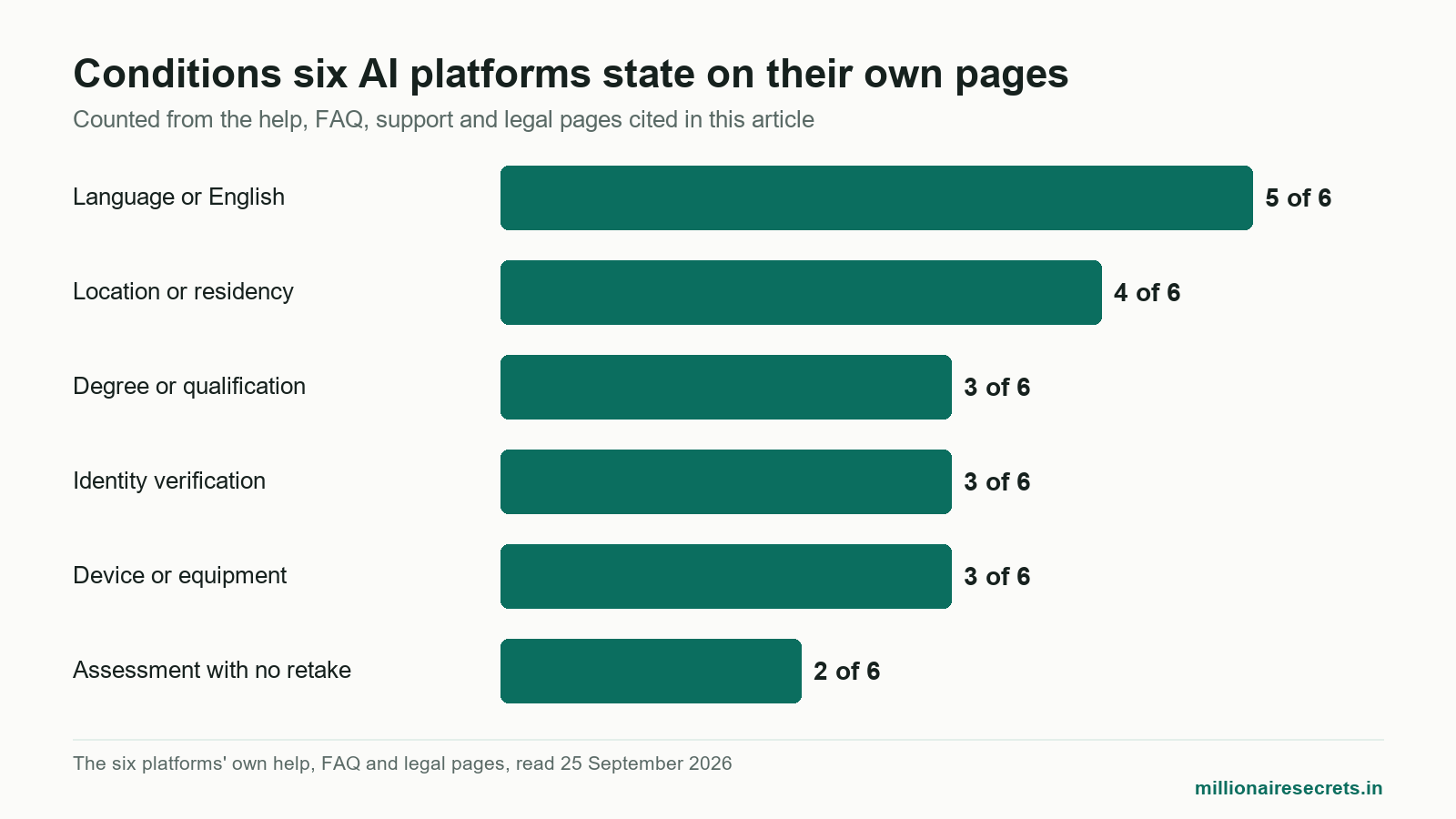
So we did the boring thing instead and read what six platforms state on their own help, FAQ and legal pages, then counted the conditions. The pattern is not subtle: a language condition appears on five of the six, and the conditions that quietly catch Indian applicants are the ones about where you are and what you are working on.

What does each platform actually say it requires?
Every row below is what the platform publishes about itself, checked on 25 September 2026. Where a platform is silent on something, we have said so rather than filled the gap in.
| Platform | What it states it requires | Assessment retake | Source |
|---|---|---|---|
| DataAnnotation | Reliable internet and fluency in English; a working device camera for identity verification; excellent writing and critical reasoning | Starter Assessment once only, no retakes | Its own FAQ |
| Appen, through CrowdGen | Eligibility set by location, language skills and qualifications; client requirements may add country, equipment access or age group | Not stated on the allocation page | Project allocation criteria |
| Clickworker, for UHRS | An assessment in two parts; the first is English and needs 80 per cent to unlock the second | You cannot repeat it | Clickworker support |
| Toloka and Mindrift | 18 or over, able to complete identity verification, not in a restricted jurisdiction; India is not on the restricted list | Not stated; qualification is by test or AI led interview | Eligibility and geographic restrictions |
| Outlier | At least an associate degree, a valid ID and mobile phone from your country of residence, a current resume and work authorisation | Qualification runs per project, not once for the account | Outlier FAQ |
| TELUS Digital, India roles | Currently residing in India, English at B2 or above, and for the mathematics role a PhD or master’s degree | Project specific qualification | A live India listing |
Read that column of retake policies again, because it is the single most expensive line on this page.
Can you retake an assessment you failed?
On two of the six, no, and both say so plainly. DataAnnotation states that the Starter Assessment can be taken once, with no retakes and no second chances. Clickworker’s UHRS article is equally blunt: you need at least 80 per cent, the first section is English and you must clear that before the second section even opens, and you cannot repeat it.
This is worth sitting with, because the common advice is to apply everywhere quickly and see what sticks. On a platform with one attempt, applying quickly is the mistake. A rushed hour on a Tuesday evening closes a door that does not reopen, which is a strange way to lose access to work you could do.
Outlier is the more forgiving shape: its FAQ describes onboarding and then qualification per project, so a single project assessment is not the whole account. Our walkthrough of what the Outlier assessment actually tests goes through the rubric properly.
Why does a shared connection or a mobile network get an account flagged?
This is the part written for somewhere other than India, and it is where a perfectly honest applicant gets caught.
Toloka’s eligibility terms, which cover Mindrift, state that you may not use VPNs, proxies “or any other method to obscure or misrepresent your location”, and that violations can end the account and forfeit payments. That rule is aimed at people faking a country. The trouble is that the signals a platform uses to detect it, an IP address that keeps moving and a location that does not sit still, are also the ordinary daily life of someone working on mobile data in an Indian city.
Household accounts are the same trap in a different shape. The platforms treat one account per person as an integrity rule, and reviewers describe accounts being closed where several family members signed up from the same home. In a country where a joint family shares one broadband line and sometimes one laptop, a rule written against fraud farms lands on a household.
None of that makes the rules unreasonable, and none of it is a reason to try to work around them. It is a reason to be boring on purpose: one account per person, no VPN at any point including during signup, and where you can, a stable connection for assessments rather than a phone hotspot in a moving auto.
Kya phone se AI training kaam ho sakta hai?
Mostly nahi, aur yeh sabse common silent rejection hai. A live TELUS Digital listing for an India based annotation project states that the work must be done on a laptop or PC desktop, that Windows 10 or higher is preferred, and that “tablets and mobile phones are not compatible”. Outlier’s FAQ asks for a valid ID and a mobile phone from your country of residence, but the phone there is for verification, not for the work.
Bahut se Indian applicants pehle phone se apply karte hain, because that is the device they have. The application form will often let you. The task platform will not. We went through the actual specifications platform by platform in what laptop AI training work really needs.
What do rejected applicants actually report?
We read the public review pages of three of these platforms. These are accounts people posted, not findings about any company, and the ratings themselves disagree sharply with each other, which is worth saying before any of it.
Outlier’s Trustpilot page carries 5,277 reviews at 4.1 out of 5, with 62 per cent at five stars and 20 per cent at one. The complaints that matter here are about removal rather than about applying: a reviewer in India reported being taken off a project while holding a quality score of 3.02, with nothing else offered in its place, and a reviewer in Colombia reported a deactivation attributed to repeated copy pasting and unusual activity after four hours of onboarding. A reviewer in the Philippines made the recurring criticism plainly, that accounts get flagged or disabled without the reason being given.
Clickworker sits far lower, at 2.4 across 3,173 reviews. A Brazilian reviewer on 9 August 2026 described an account permanently closed after family members registered their own accounts, with an offer to verify by ID refused. A South African reviewer on 12 August 2026 was told a failed reward was down to VPN or connection issues. Both are the integrity machinery described above, seen from the receiving end.
Appen’s page is the harshest, 1.4 out of 5, though across only 371 reviews, so it is a small and self selected sample. Indian reviewers there write about pay and about qualification difficulty rather than about the application itself: one on 26 April 2026 called the qualification assessments hard and the rates low, and one on 22 November 2025 reported rates of two dollars an hour or less.
Where the accounts and the official pages agree: the platforms do reject and deactivate on automated integrity signals, exactly as their terms reserve the right to do. Where they part company: the terms describe an appeal or a verification step, and a recurring complaint is that the appeal goes unanswered. We could not verify any individual case, and none of these accounts establishes what any platform did.
How do you fix a profile before applying again?
Work through the conditions the platforms actually publish, in the order they bite.
- Match the profile to the stated condition, not to the job title. Appen’s own allocation page says eligibility rests on the information you gave at signup, so a blank or vague field is a filter you applied to yourself.
- Fill in language properly. Five of the six state a language condition, and Clickworker gates the entire UHRS assessment behind an English section at 80 per cent.
- Get the identity step ready before you start: a valid government ID, a working camera, and the name matching across the ID, the profile and the payment account.
- Do the one shot assessments last, on a laptop, on a stable connection, on a day you have two clear hours.
- One account per person and no VPN, ever, including the day you sign up.
If a platform has already said no, the useful move is sideways rather than repeated. Our list of which AI training platforms actually accept India is the place to start, why DataAnnotation rejects Indian applicants covers the strictest of them, and Toloka and Mindrift in India covers the platform whose terms are quoted above. For the paperwork side, the documents Indian online workers actually need lists what the verification steps ask for.
General information only. Platform rules change without notice and were checked on 25 September 2026.
Profile check before you apply again
Every item here is a condition one of the six platforms states on its own page. Work down it before you open another application.
Ticks are saved on this device only. General information, not career or legal advice.
Frequently asked questions
Does a VPN really get you rejected on AI platforms?
Toloka’s eligibility terms, which cover Mindrift, state that you may not use a VPN, a proxy or any other method to obscure or misrepresent your location, and that a violation can end the account and forfeit payments. Other platforms carry similar clauses. There is no upside to using one.
Kya ek ghar se do log alag alag account bana sakte hain?
Platform ki terms padhna zaroori hai. The rule is normally one account per person, but reviewers describe accounts closed where several family members signed up from the same home and the same connection. Agar ghar mein do log apply kar rahe hain, har ek apna ID aur apna payment account use kare.
How long does an AI platform take to respond to an application?
There is no published timeline on any of the six pages we read, and DataAnnotation states it cannot respond to every applicant individually. Treat silence as a likely no after a few weeks, rather than as a decision still pending.
Is a degree compulsory for AI training work?
It depends on the platform and on the project. Outlier’s FAQ states at least an associate degree. A TELUS listing for an India based mathematics annotation project asks for a PhD or master’s degree. Appen sets qualifications per client project, so some have no degree condition at all.
Can you apply again after a rejection?
On some platforms yes, on others the assessment itself cannot be repeated. DataAnnotation states the Starter Assessment is once only, and Clickworker states its UHRS assessment cannot be repeated. Where the block is the assessment rather than the account, a different platform is the faster route.
Does an Indian bank account cause a rejection?
Not on its own, but the payment step is a real gate. Outlier pays via PayPal, Airtm or ACH bank transfer, and DataAnnotation pays via PayPal, so an applicant who cannot complete the payment setup in their own name can stall after being accepted.
Finished the page? The same five questions from the top, to see what stuck.
Platform rules and rates change without notice. This page was verified in September 2026 and is rechecked on the Sunday refresh. If you hit something different, tell us in the comments and we will update it.

Leave a Reply