
A UPI fraud complaint goes to your own bank first, within three working days of the debit alert, the window in which RBI’s rules give you zero liability. Call 1930 the same day so the money can be frozen. If the bank refuses or stays silent for 30 days, the RBI Ombudsman comes next.
Listen to this article, about 13 minutes. A synthetic voice reads the article and announces each section title as it begins; tables are read row by row and the questions at the end are left out.
Recorded 2 October 2026 from the article as published that day. Press a chapter to jump there; the highlighted line is what is playing. A play button sits beside every section heading, and once you scroll past this player a bar at the bottom of the screen keeps the controls in reach. Tap or click any sentence to hear the reading start from there.
On this page: the three complaint routes in the order they matter, the RBI Ombudsman’s new 90 day limit checked on 2 October 2026, the 2027 compensation rule worked out at six loss amounts, and four consumer commission orders with the amounts banks were told to repay.
Think you already know this? Five questions, one minute.
Every answer is on this page. Answer from what you know now; the page fills in the rest.
-
1. According to NPCI, where does a complaint about a fraudulent UPI transaction go?
NPCI’s complaint page tells users raising a fraud complaint to connect with their bank; UPI Help is for failed and pending payments. Read the section
-
2. Within how many working days must a third party breach be reported for zero liability?
The RBI notification gives zero liability where the customer notifies the bank within three working days; days four to seven carry a capped liability. Read the section
-
3. In the Chandigarh UPI case reported in November 2025, what did the bank argue?
The bank relied on PIN authentication, but the District Commission found it had missed the 10 working day credit and the 90 day inquiry limits. Read the section
-
4. Under the RBI Ombudsman scheme in force since 1 July 2026, how long do you have to file after the bank’s 30 days run out?
The RB-IOS 2026 FAQ sets 90 days from the expiry of the timeline or the bank’s last reply, whichever is later. The 2021 scheme allowed one year. Read the section
-
5. From 1 January 2027, what is the most a small value fraud victim can receive under the new compensation rule?
The final directions, as reported by MediaNama, give 85 percent of net loss or Rs 25,000, whichever is lower, for losses up to Rs 50,000. The RBI press release confirms the start date. Read the section
Most pages on this query say call 1930 and stop. That is half the job. The police route can freeze money still sitting in a mule account; only your bank can put money back in yours. Below: the three routes in order, the rule that changed on 1 July 2026, the one that changes on 1 January 2027, and what consumer commissions ordered when banks said no.
Where does a UPI fraud complaint actually go?
Three places, and they do different jobs. The common mistake is assuming the UPI app’s own help button covers fraud. It does not. NPCI’s complaint page says that if the complaint is about a fraudulent transaction, the user has to connect with their bank. UPI Help is built for payments that failed, got stuck as pending, or debited twice.
| Where | What it is for | Clock that matters | Source |
|---|---|---|---|
| Helpline 1930 and the cybercrime portal | Police side: freezing money still sitting in the receiving accounts, and the acknowledgement number | Same day; from 1 January 2027 also the five calendar day window for compensation | cybercrime.gov.in |
| Your own bank (the one your UPI is linked to) | The money side: reporting the debit, shadow credit, liability decision | Three working days for zero liability; bank must credit within 10 working days and decide within 90 days | RBI customer liability rules |
| UPI Help inside your payment app | Failed, pending and wrongly debited transactions | Not the route for fraud: NPCI tells fraud victims to go to their bank | NPCI complaint page |
| RBI Ombudsman | When the bank does not reply in 30 days or rejects you | File within 90 days of that, under the 2026 scheme | RB-IOS 2026 FAQ |
So the order on the day is: 1930 or the National Cyber Crime Reporting Portal for the freeze, then your bank’s fraud line or branch in writing for the money, keeping the complaint reference from both. Our guide to filing the 1930 and cybercrime portal complaint walks through the police side screen by screen, and tracking the acknowledgement number afterwards covers what happens to it next.
Where is your complaint right now?
Pick the stage you are at to see the next route this page describes. General information only.
A route finder, not advice about a specific case. Choices are saved on this device only.
Does the three working day rule cover a payment you approved yourself?
This is the uncomfortable part, and no ranking page says it plainly. The RBI rule most guides quote, first issued on 6 July 2017, is about unauthorised electronic transactions: money that left your account without you approving it. Under the RBI notification you carry zero liability where the bank was at fault, or where the breach was elsewhere in the system and you told the bank within three working days. The days are counted by your home branch’s working schedule, not counting the day the alert arrived.
| When you tell the bank (third party breach) | Basic savings (BSBD) account | Savings account, most cards | Other current accounts, cards above Rs 5 lakh limit |
|---|---|---|---|
| Within 3 working days | Zero | Zero | Zero |
| Day 4 to day 7 | Up to Rs 5,000 | Up to Rs 10,000 | Up to Rs 25,000 |
| After day 7 | Set by bank policy | Set by bank policy | Set by bank policy |
The same notification puts the burden of proving customer liability on the bank, requires it to credit the amount within 10 working days of your report, and gives it at most 90 days to resolve the complaint. Those three lines are the ones that win cases, as the records below show.
Now the catch. If a caller talked you into typing your UPI PIN to “receive” a refund, or you scanned a QR code to collect money, the bank will argue the payment was authorised by you. Today’s rules were written for card cloning and hacked accounts, not for persuasion. Until 2027, a payment you were tricked into making is the weakest kind of UPI fraud complaint, and that is a fact about the rules, not a judgement about anyone who fell for it. The Telegram task scam and its cousins are built by professionals.
What did consumer commissions order when banks said no?
We read five published consumer commission records on disputed electronic transactions, four from LiveLaw’s reports and one from its February 2026 digest, plus the seven fraud accounts on the UPI page of ConsumerComplaints.in. These are case records and complaints, reported here as what happened in those cases, not as a promise of what happens in yours.
Bank liable, Chandigarh, UPI. In a case reported on 15 November 2025 (DC/AB1/44/CC/359/2023), five unauthorised UPI debits totalling Rs 99,940 left an SBI account on 21 July 2021. The customer went to the cyber cell that day and the bank the next. SBI argued that a UPI debit needs the secret PIN, so the customer must be liable. The District Commission disagreed: the bank never credited the money within 10 working days, never finished its inquiry in 90 days, and produced no proof of customer fault. Refund with 9 percent interest from 2021, plus Rs 10,000.
Bank liable, national level. On 11 December 2024 the National Commission (R.P. No. 1551/2023) upheld a refund of Rs 9 lakh, two transfers of Rs 4.5 lakh each made after a SIM replacement request, with 7 percent interest, Rs 15,000 compensation and Rs 10,000 costs. The bank’s defence was that OTPs went to the registered number. The Commission’s answer was the three day rule and the absence of any fault by the customer.
Bank liable, card. The Chandigarh District Commission’s order in CC/255/2021, summarised in LiveLaw’s February 2026 digest, ordered a refund of disputed card charges, a correction of the credit record and compensation, because the cardholder had reported promptly.
Customer lost, Goa. On 28 November 2024 the Goa State Commission (First Appeal 27 of 2024) reversed a win. A caller posing as a travel refund desk had the customer install a remote access app and share credentials; Rs 35,000 left by net banking. The Commission held the bank could not be made liable where the customer had bypassed every safeguard.
The pattern across them is consistent. Where the customer had not shared a PIN or OTP and reported fast, the bank’s own failure to follow the 10 day and 90 day rules sank it. Where the customer handed over access, the claim failed. The seven ConsumerComplaints.in accounts, dated April 2021 to January 2024, mostly involve shared PINs, fake QR codes and job scams, and none of them reports money coming back. One quotes the bank telling the customer to complain in UPI because the bank was not responsible, which is exactly backwards according to NPCI.
Bank ne mana kar diya, ab kya?
Then it goes to the RBI Ombudsman, and here most pages are now out of date. The Reserve Bank’s Integrated Ombudsman Scheme was replaced on 1 July 2026. Per the RBI’s own FAQ on the 2026 scheme:
You can file once the bank has not replied within 30 days, or has replied and you are not satisfied. The complaint must reach the Ombudsman within 90 days of that 30 day timeline expiring or of the bank’s last reply, whichever is later. Under the 2021 scheme it was one year, and most guides ranking for this query still say one year. Plan on 90.
Filing is free, on cms.rbi.org.in, with the toll free line 14448 for status help. You need the bank’s complaint number and date, a copy of what you sent, the transaction reference (UTR) and the bank’s reply if any. The Ombudsman can award compensation up to Rs 30 lakh for consequential loss plus up to Rs 3 lakh for time, expense and harassment; pages quoting Rs 20 lakh are describing the old scheme. A police investigation running in parallel does not block an Ombudsman complaint, according to the same FAQ.
Agar kisi ne “recovery agent” bankar fee maangi, toh samajh jaiye doosra scam shuru ho gaya. The Ombudsman and the portal charge nothing; our piece on getting money back after an earning app fraud covers the recovery agent trick in detail.
What changes for UPI fraud on 1 January 2027?
On 24 June 2026 the RBI announced amendment directions that apply to electronic banking transactions from 1 January 2027 at commercial, small finance, payments, local area, regional rural and co-operative banks. The press release says they widen the old unauthorised transaction rules to cover other categories of fraudulent transactions, shorten how long banks take on these complaints, and add compensation for small value fraud.
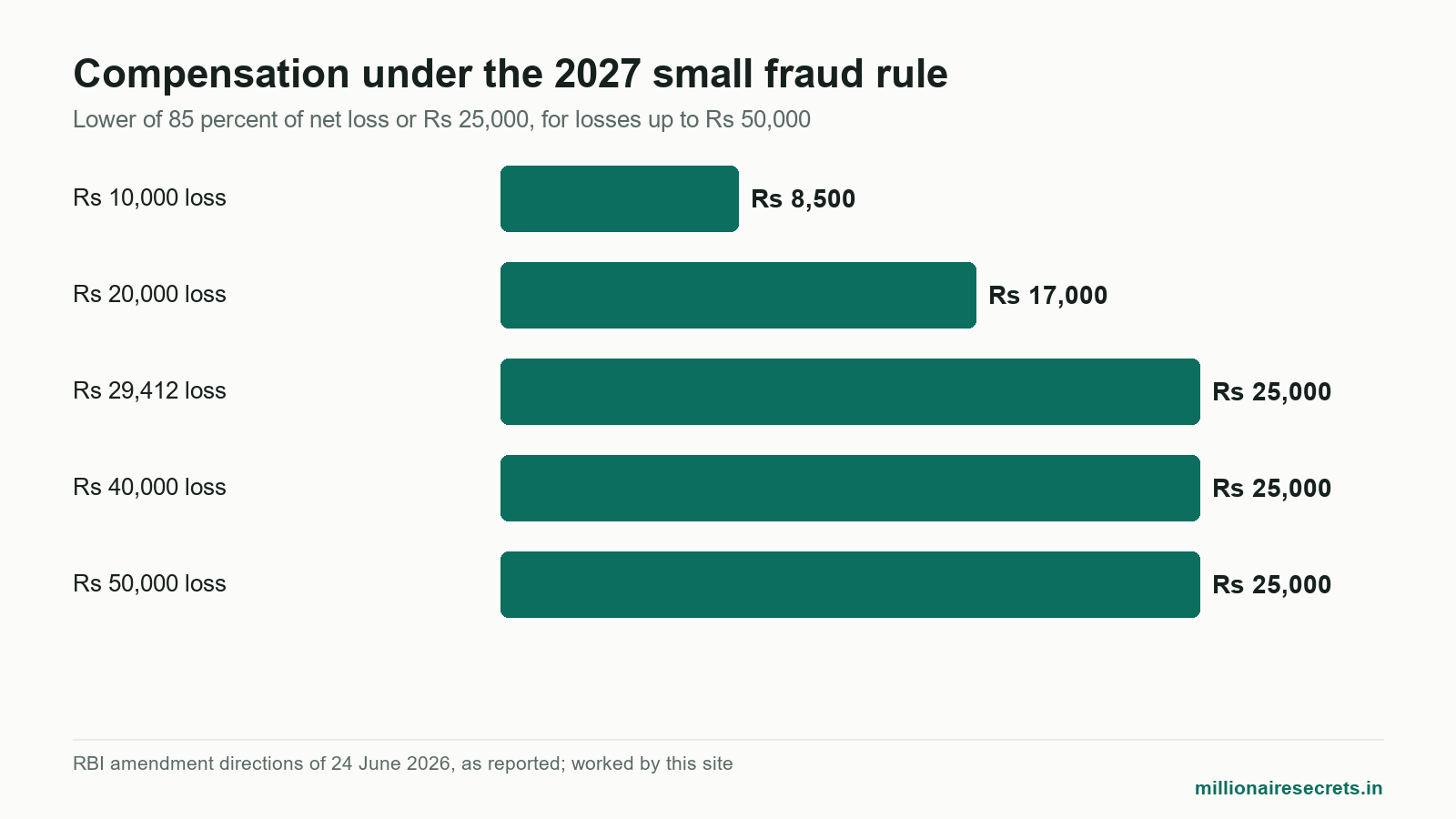
The detail, as MediaNama reported the final text: a fraudulent transaction now includes one made by a third party using credentials obtained by deceit, and one made by the customer under coercion. Bona fide victims of such a transaction with a loss of up to Rs 50,000, including cases involving customer negligence, can get 85 percent of the net loss or Rs 25,000, whichever is lower, once in a lifetime, if they report to the bank and to 1930 or the cybercrime portal within five calendar days. We could not open the directions PDF itself on the RBI site, which served a captcha, so treat these figures as reported until your bank publishes its updated policy.
| Net loss | 85 percent of it | Compensation under the 2027 rule |
|---|---|---|
| Rs 10,000 | Rs 8,500 | Rs 8,500 |
| Rs 20,000 | Rs 17,000 | Rs 17,000 |
| Rs 29,412 | Rs 25,000 | Rs 25,000 (the point where the cap starts to bite) |
| Rs 40,000 | Rs 34,000 | Rs 25,000 |
| Rs 50,000 | Rs 42,500 | Rs 25,000 |
| Rs 60,000 | Rs 51,000 | Nothing under this scheme: the loss is above Rs 50,000 |
Note what the arithmetic means. Anything above about Rs 29,400 hits the Rs 25,000 ceiling, and anything above Rs 50,000 falls outside this scheme entirely and goes back to the ordinary liability rules. And five calendar days is not three working days: a Saturday counts. A fraud before 1 January 2027 is judged under today’s rules.
Yeh sab general information hai, legal ya financial advice nahi. Every case turns on its facts and on what your bank’s own policy says.
What should a UPI fraud complaint to the bank contain?
Write it, even if you also called. A phone complaint with no reference number is hard to prove in front of the Ombudsman. Put these in the first message: the UPI transaction reference (UTR) for every debit, the date and time of each, the amount, the receiving UPI ID or account shown in the app, when you first saw the alert, the 1930 or portal acknowledgement number, and a single plain sentence on whether you shared a PIN or OTP. Ask in writing for the shadow credit within 10 working days and for the bank’s decision with reasons.

Keep screenshots of the debit SMS, app history and the fraudster’s chat. If a mule account received the money, our explainer on how mule accounts are recruited shows why the freeze has to happen fast, and when a 1930 complaint becomes an FIR covers the police step that some banks insist on. For the wider list of scam patterns this site tracks, start at our fake earning apps guide.
Your UPI fraud complaint pack
Tick each item once it is in your written complaint to the bank. This is a list of what the RBI’s Ombudsman FAQ and the bank will ask for, not legal advice.
Ticks are saved on this device only.
Frequently asked questions
Can I raise a UPI fraud complaint through the UPI Help option in my app?
UPI Help is meant for failed, pending and wrongly debited payments. For fraud, NPCI’s complaint page directs users to their own bank, so report to the bank in writing and to 1930 as well.
UPI fraud complaint ka time limit kya hai?
Bank ko teen working days ke andar batana zero liability ke liye zaroori hai. 1 January 2027 se chhote fraud ke compensation ke liye bank aur 1930 dono ko paanch calendar days ke andar batana hoga.
What if my bank does not reply to my complaint?
After 30 days without a reply, or after a reply you disagree with, you can complain to the RBI Ombudsman at cms.rbi.org.in. Under the scheme in force since 1 July 2026, that complaint must be filed within 90 days.
Is the Rs 25,000 compensation available for a fraud that happened in 2026?
No. The amendment directions apply to transactions from 1 January 2027. Frauds before that date are handled under the existing liability rules and the bank’s own policy.
Kya Ombudsman complaint ke liye wakil ya agent chahiye?
Nahi. Filing free hai aur RBI ka FAQ kehta hai ki kisi third party agency ko fee dene ki zaroorat nahi. Jo agent recovery ke naam par advance maange, usse door rahiye.
Does filing a police complaint stop me from going to the RBI Ombudsman?
No. The RBI’s FAQ on the 2026 scheme says a police investigation or criminal case is not treated as the same grievance, so the two can run side by side.
Finished the page? The same five questions from the top, to see what stuck.
Platform rules and rates change without notice. This page was verified in October 2026 and is rechecked on the Sunday refresh. If you hit something different, tell us in the comments and we will update it.

Leave a Reply