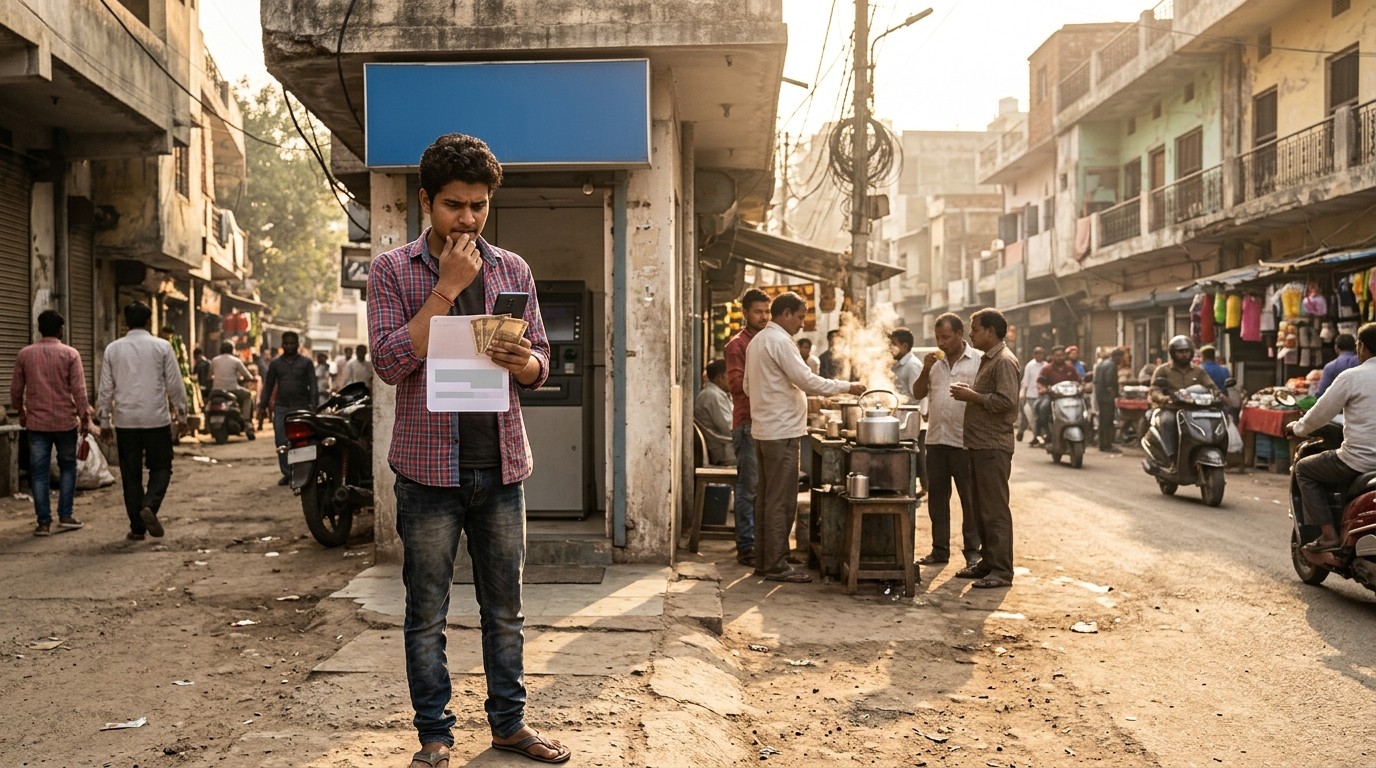
If a remote job asks for your passbook, debit card, ATM PIN or a SIM registered in your name, the job is not the product. Your bank account is. That is a mule account setup, and the account holder is the person police trace first. In India the consequences run from a frozen account to a case under the money laundering law.
Most work from home scams take money from you. This one is quieter, because at first it takes nothing. You get hired, you are told the company needs a verified account for salary processing, and for a few weeks a small commission actually lands. Then one morning your UPI stops working and a police station in a district you have never visited wants a statement.
Mule account kya hai, aur aapka naam ismein kaise aa jaata hai?
A mule account is an ordinary bank account, opened with real KYC by a real person, that somebody else then uses to move the proceeds of a crime. Nothing about the account is fake, and that is the point. Stolen money needs to pass through accounts that look normal to a bank’s fraud systems, and the cheapest way to get one is to recruit a person who will open it voluntarily.
The wrapper changes. Sometimes it is a loan agent, sometimes a crypto group, sometimes a relative with a business problem. Increasingly it is a job offer, because a job offer explains away every strange request. Salary account. Verification deposit. Client settlement. Each phrase makes a crime sound like paperwork.
What does the pitch actually sound like?
Reporting in August 2026 on a case worked by the Cyber Crime Police Station in Patiala lays out the pattern. Recruiters posing as HR executives at reputable companies offered remote work with a good salary and almost no experience needed, asked for a processing or verification fee, then asked candidates to open fresh bank accounts and hand over the passbook, the debit card and the SIM registered in their name.
Those bundles, which the reporting calls pre activated bank kits, went to handlers abroad. Investigators found the accounts being operated from IP addresses geolocated in the Philippines. In that one investigation about Rs 2.99 crore moved through 18 mule accounts between February and June 2025. Police recovered 231 SIM cards and 18 debit cards, arrested four principal accused and froze part of the proceeds.
Notice what the fee does. Paying it converts you from a stranger into someone already invested, so by the time the account request arrives, refusing feels like losing a job you paid for. The same lever runs the data entry fee scam and the Telegram prepaid task scam.
How big is this, really?
Big enough that banks now treat it as an infrastructure problem. A Ministry of Home Affairs reply in March 2026 recorded 11,126 online job fraud incidents for 2025 on the National Cyber Crime Reporting Portal. Figures attributed to the Indian Cyber Crime Coordination Centre put more than 2.47 million first layer mule accounts flagged as of early 2026. Treat that second figure as an order of magnitude, not a count, because it comes from press reporting rather than a published dataset.
Freeze ho gaya to account ka kya hota hai?
Frozen is not one thing, and the depth of the restriction decides how bad your month is.
| Restriction | What still works | Practical effect |
|---|---|---|
| Lien on a disputed amount | Everything above the lien amount | Salary credits still land, that specific sum is untouchable |
| Debit freeze | Money comes in, nothing goes out | Balance visible and useless, EMIs and autopay bounce |
| Full freeze | Nothing | Non operational until the agency or a court releases it |
| Digital channel suspension | Branch transactions, sometimes | UPI, cards and net banking dead, which is how most people find out |
The basis usually cited for the seizure is Section 106 of the Bharatiya Nagarik Suraksha Sanhita, which replaced Section 102 of the old Criminal Procedure Code. It lets a police officer seize property suspected to be stolen, and requires a report to a magistrate. Restrictions also arrive through cyber police notices and through the complaint system behind the 1930 helpline, which alerts both banks in a transaction. The person on the other side of that hold sees it too, because the amount put under lien shows up in their cyber crime complaint tracking alongside the status of the case.
A bank will generally not release funds held on a law enforcement instruction. Getting money out usually needs an order from the magistrate court handling the case, a route practitioner guidance still cites by its old numbering, Sections 451 and 457. At that stage you want a local lawyer, not a blog.

Can you be prosecuted if you genuinely did not know?
This is where people want a comfortable answer and there is not one. Section 3 of the Prevention of Money Laundering Act reaches anyone knowingly assisting, or knowingly a party to, any process connected with the proceeds of crime. Section 4 sets rigorous imprisonment of not less than three years and up to seven, plus a fine, extending to ten years for certain specified offences.
The word doing the work is knowingly. Genuine absence of knowledge is a defence, and plenty of account holders end up treated as witnesses rather than accused. But legal commentary is consistent that wilful blindness is not innocence. If you took a commission to hand over a card and a SIM and asked nothing, arguing that you never wondered why is weak. Section 66D of the Information Technology Act and the cheating and stolen property provisions of the Bharatiya Nyaya Sanhita are commonly added too.
Set against the commission on offer, usually a few thousand rupees a month, this is a spectacularly bad trade. One frozen salary account costs more in a fortnight of chaos than the scheme pays in a year.
Why are banks catching these accounts faster now?
Because detection stopped being manual. The Reserve Bank Innovation Hub built a machine learning model called MuleHunter.AI that hunts for mule behaviour in transaction patterns. Reporting in 2026 describes it live at 26 banks, with the Ministry of Home Affairs pushing financial institutions to integrate by December 2026, and cites a figure around 20,000 accounts a month.
Here the sources genuinely disagree and we will not paper over it. An August 2025 report had 15 more banks joining by that October, while 2026 reporting gives 26 live, and those cannot both describe the same rollout. The 20,000 figure is called detection capability in some reports and actual monthly blocks in others. The count does not matter to you. What matters is that an account taking many small credits from unrelated senders and pushing them straight out now gets noticed with nobody complaining about you at all.
Which employer requests are normal and which are not?
Real employers do ask for financial details. The line is not whether they ask, it is what the details let them do.
| Request | Normal or not | Why |
|---|---|---|
| Account number and IFSC for salary credit | Normal | These let money in, not out |
| PAN, and a cancelled cheque or passbook first page | Normal | Standard for payouts and tax reporting |
| Open a new account at a bank they name | Red flag | No employer needs your account at a specific bank |
| Physical passbook, debit card or cheque book handed over | Stop | Nothing legitimate needs possession of your instruments |
| ATM PIN, OTP, UPI PIN or net banking login | Stop | Only an operator of your account needs these |
| A SIM in your name, kept by them | Stop | The SIM is the second factor on the account |
| Registration, training or verification fee | Red flag | Payment flows employer to worker, never the reverse |
One test covers most of it. Anything that lets someone push money out of your account, or receive the message authorising it, is not onboarding. A famous brand on the email does not change that, which is the subject of our post on fake Amazon and Flipkart work from home offers, and the wider principle sits in whether online earning without investment is actually possible. The platforms that genuinely accept Indian applicants ask for a PAN and an account number, full stop.
Aapka account freeze ho gaya hai. Ab kya karein?
Speed and paper, in that order.
- Ask the bank in writing for the date of the restriction, the amount under lien, the complaint reference number and which police station instructed it. You are entitled to know what you are answering.
- Pull the statement and mark every disputed credit and debit yourself, before anyone asks you to.
- Stop contact with the recruiters, but delete nothing. Chats, call logs, the offer letter, the fee receipt and the account opening papers are your evidence.
- File your own complaint at cybercrime.gov.in and call 1930. Being on record as the person who reported it beats being discovered. Our guide to reporting online fraud through 1930 and the cybercrime portal covers what the operator asks for.
- Send a factual representation to the bank and the investigating officer explaining each flagged transaction, and ask for any hold to be limited to the disputed amount.
- Get a local lawyer before you give a statement, especially if money laundering has been mentioned.
If you lost money to this network rather than lending it an account, the timing rules are harsher. We cover them in whether money lost to an earning app can come back.
One thing not to do. No private agency can unfreeze a bank account. Anyone advertising that service to you right now found your name on a list of people whose accounts were frozen, and they are the second scam, not the fix.
Frequently asked questions
Is it illegal to let someone else use my bank account?
Yes, in substance. If the account is used to move proceeds of crime, Section 3 of the Prevention of Money Laundering Act reaches anyone knowingly a party to the process, and Section 4 sets rigorous imprisonment of three to seven years plus a fine, extending to ten years for certain specified offences. Cheating and stolen property provisions and Section 66D of the Information Technology Act are commonly added, depending on the first information report.
Mera account freeze ho gaya aur mujhe kuch pata nahi tha. Kya hoga?
Genuine absence of knowledge is a defence, and many account holders are treated as witnesses rather than accused. But wilful blindness is not innocence in the eyes of the law. Get the freeze details in writing from the bank, file your own complaint at cybercrime.gov.in, keep every chat and receipt, and take a local lawyer before giving a statement.
Salary ke liye account number dena safe hai ya nahi?
Account number and IFSC are safe to share, because they only let money come in. PAN and a passbook first page image are also standard for payouts. What is never safe is your ATM PIN, OTP, UPI PIN or net banking login, or handing over the physical card, passbook or a SIM in your name.
Can the bank unfreeze my account if I explain what happened?
Usually not on its own. When funds are held on a law enforcement instruction, the bank generally waits for the agency or a court. Getting money released commonly needs an order from the magistrate court handling the case, and practitioner guidance still cites the old Criminal Procedure Code Sections 451 and 457 for that route, now renumbered under the Bharatiya Nagarik Suraksha Sanhita.
Kya koi agency paisa dekar account unfreeze karwa sakti hai?
Nahi. No private agency can unfreeze a bank account, because only the investigating agency or a court can. Lists of people whose accounts were frozen get resold, so an unsolicited offer to fix your freeze for a fee is the second scam arriving on schedule.
How do banks find mule accounts now?
By transaction pattern rather than by complaint. The Reserve Bank Innovation Hub built a machine learning model called MuleHunter.AI, reported live at 26 banks in 2026 with the Ministry of Home Affairs pushing integration across financial institutions by December 2026. Reports differ on the rollout count and on whether the widely quoted 20,000 accounts a month is capability or actual blocks.
General information about how a fraud pattern works and what Indian law says about it. It is not legal advice and is no substitute for a lawyer who can see your first information report and your bank correspondence. Verified on 4 September 2026 against reporting on the Patiala mule account case, Ministry of Home Affairs figures for 2025 job fraud complaints, and press coverage of the MuleHunter.AI rollout. Sources disagree on the rollout count and we say so above. If you hit something different, tell us in the comments and we will update it.

Leave a Reply