
Most freelancers in India do not need GST registration until their total turnover crosses Rs 20 lakh in a year, and that stays true even when every client is abroad. A 2017 notification carves service exporters out of the general rule that inter-state suppliers must register regardless of turnover.
Listen to this article, about 8 minutes. A synthetic voice reads the article and announces each section title as it begins; tables are read row by row and the questions at the end are left out.
Recorded 30 September 2026 from the article as published that day. Press a chapter to jump there; the highlighted line is what is playing. A play button sits beside every section heading, and once you scroll past this player a bar at the bottom of the screen keeps the controls in reach. Tap or click any sentence to hear the reading start from there.
On this page: the exact 2017 notification that exempts small freelancers with foreign clients from compulsory GST registration, quoted from the CBIC’s own flyer, the registration clock once you cross Rs 20 lakh, and the penalty math most guides skip.
Think you already know this? Five questions, one minute.
Every answer is on this page. Answer from what you know now; the page fills in the rest.
-
1. What is the GST registration threshold for a freelancer selling only services, in most of India?
The CBIC’s own registration flyer sets Rs 20 lakh a year as the all India threshold for service suppliers, dropping to Rs 10 lakh only in four states. Read the section
-
2. Under Section 24 of the CGST Act, does an inter-state supply of services always require compulsory registration regardless of turnover?
Notification 10/2017, Integrated Tax exempts small inter-state service suppliers, export included, from the compulsory registration rule below the Rs 20 lakh or Rs 10 lakh threshold. Read the section
-
3. Once your turnover crosses the threshold, how long do you have to apply for GST registration?
The CBIC flyer requires the online application within thirty days of the date the liability to register arose, not the date you notice it. Read the section
-
4. Can a freelancer whose clients are all abroad use the 6 percent composition scheme?
Composition scheme rules bar inter-state supply entirely, and export of services is treated as one, which rules out most platform freelancers. See our GST and LUT guide for what registered exporters file instead. Read the section
-
5. What is the minimum penalty under Section 122 of the CGST Act for failing to register when required?
Section 122 of the CGST Act sets the penalty at Rs 10,000 or 10 percent of the unpaid tax, whichever is higher, rising to 100 percent where the failure is deliberate evasion. Read the section
This gets confused constantly, and not only on forums. Somewhere between the plain reading of Section 24 of the CGST Act and the notification that quietly carves an exception into it, a lot of freelancer advice online stops reading.
Do freelancers need GST registration at all?
Registration follows turnover, not profession. The CBIC’s own flyer on registration puts it plainly: small businesses with all India aggregate turnover below the threshold need not register, though they can opt in voluntarily. For a freelancer selling services, that threshold is Rs 20 lakh a year, measured across every client and every platform combined, not per client and not per platform.
| Your supply | Threshold that triggers registration | Where it drops to Rs 10 lakh |
|---|---|---|
| Services only, sold anywhere including abroad | Rs 20 lakh a year, all India | Manipur, Mizoram, Nagaland, Tripura |
| Goods only | Rs 40 lakh a year, all India | Arunachal Pradesh, Manipur, Meghalaya, Mizoram, Nagaland, Puducherry, Sikkim, Telangana, Tripura, Uttarakhand (Rs 20 lakh there) |
| A mix of goods and services | Rs 20 lakh a year, all India | Manipur, Mizoram, Nagaland, Tripura |
Two things trip people up in that table. First, aggregate turnover counts everything you bill, GST or no GST, before any expense is deducted; it is not take home income. Second, the Rs 10 lakh states for services (Manipur, Mizoram, Nagaland, Tripura) are a shorter list than the Rs 20 lakh-becomes-Rs-20-lakh states for goods. A freelancer based in Sikkim or Uttarakhand, for instance, still gets the full Rs 20 lakh threshold for services, even though those states sit on the goods list at a lower number. Confuse the two lists and you can talk yourself into registering two years early.
Nobody tracks this threshold for you. Upwork, Fiverr and a platform like Mindrift or Outlier pay out in dollars and have no obligation to tell the Indian tax system anything about your GST position, and neither does Wise or Payoneer when the money lands in your account. The running total lives on your own invoices or platform statements, which is also the first thing a chartered accountant will ask to see if you ever do need to register: not a bank statement, a list of what you billed, month by month, back to when the financial year started.
Does having only foreign clients change the rule?
This is the actual point of confusion, and it has a paper trail. A freelancer or chartered accountant asking this exact question, word for word, is sitting in a public forum thread on caclubindia right now, because Section 24 of the CGST Act says inter-state suppliers must register compulsorily, with no turnover exemption, and export of services is treated as an inter-state supply under the IGST Act. Read only that far and the conclusion looks obvious: any freelancer with a single foreign client must register, from rupee one.
That reading skips a notification. Notification No. 10/2017, Integrated Tax, dated 13 October 2017 and amended by Notification No. 03/2019, Integrated Tax, specifically exempts persons making inter-state supplies of taxable services from that compulsory registration requirement, provided their all India turnover stays within Rs 20 lakh, or Rs 10 lakh in the four states above. The CBIC flyer restates it in its own words: small suppliers of services are exempted from registration, even if they supply services outside the state. Outside the state covers outside the country; an export is simply the furthest version of an inter-state supply. Our own guide to the LUT that lets you invoice foreign clients without charging IGST touches this threshold in passing; this is the fuller version, because the exemption is the reason most freelancers never reach the LUT question in the first place.

What happens once you cross the Rs 20 lakh line?
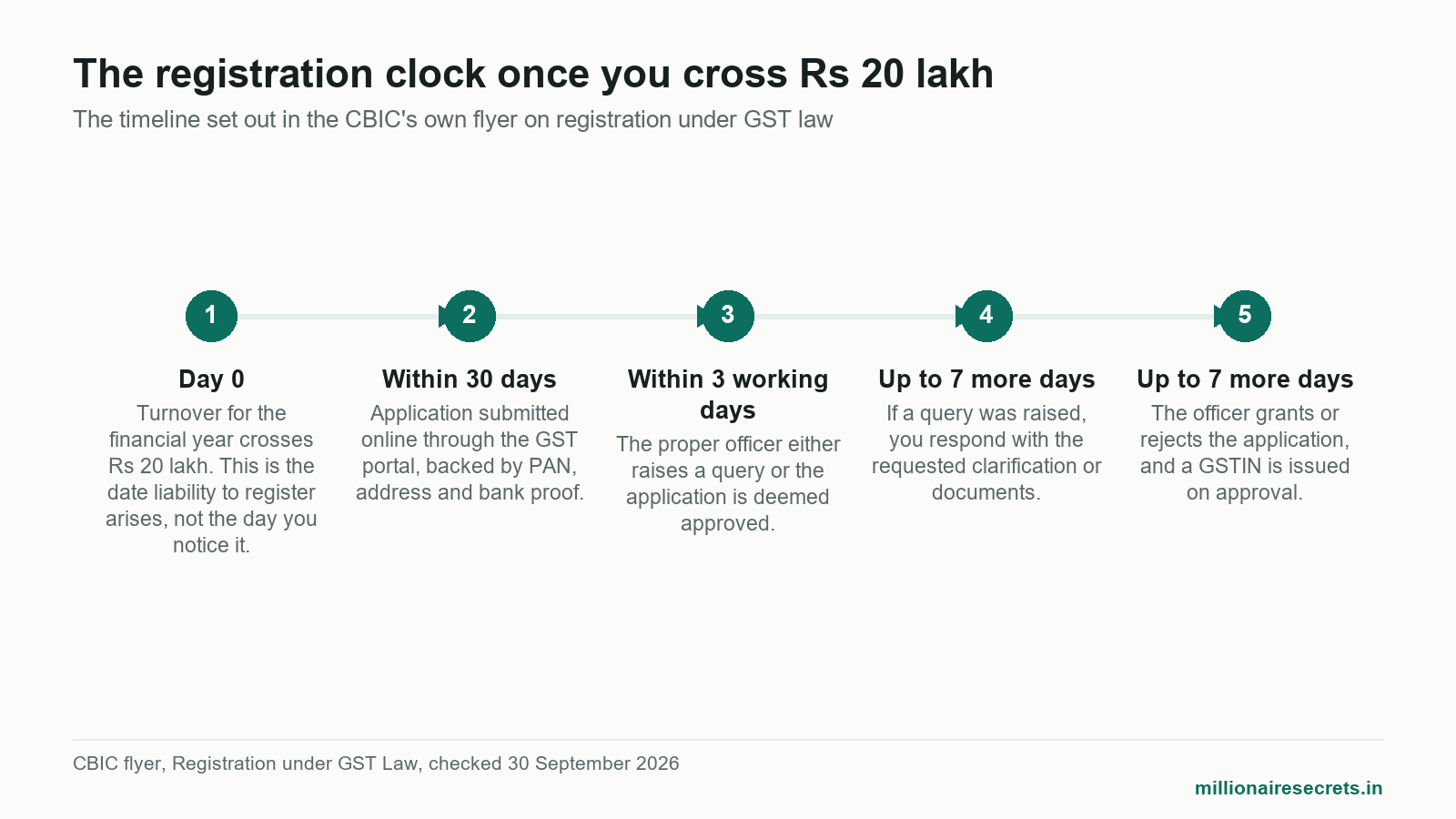
The CBIC flyer sets a firm clock: registration has to be applied for online, through the GST portal, within thirty days of the date your liability arises, which is the day your cumulative turnover for the year crosses the threshold, not the day you notice it did. The portal’s proper officer then has three working days to either raise a query or let the application be deemed approved; if a query is raised, you get seven working days to answer it, and a decision follows within a further seven working days.
Approval gets you a 15-digit GSTIN: the first two digits are your state code, the next ten are your PAN, the next two are an entity code, and the last is a checksum digit. Registration is PAN based and state specific, so a freelancer working from one city needs exactly one GSTIN, not one per client or platform. Filing starts the month you are registered, whether or not you have billed anything that month yet.
Is voluntary registration ever worth it before you must?
Sometimes. Registering early lets you claim input tax credit on the GST you pay for a laptop, software subscriptions or a coworking desk, and it gives an invoice a GSTIN line that some larger clients ask for before they will onboard a vendor. It also used to be a one way door: before a rule change on 23 January 2018, a voluntary registration could not be cancelled until a full year had passed. That lock is gone. Voluntary registration can now be cancelled any time you choose, which takes most of the risk out of registering a little early.
One popular shortcut does not apply here, though. The composition scheme lets small service providers pay a flat 6% instead of 18% and file quarterly, but it is closed to anyone making an inter-state supply, and export of services counts as one. Agar aap Upwork, Fiverr ya kisi bhi foreign platform se kamate hain, to composition scheme legally aapke liye hai hi nahi, turnover chahe jitna bhi kam ho. That single condition rules out most of this site’s readers before the 6% rate even becomes a real choice.

Where do you sit on the registration threshold?
Pick the range your last twelve months of billing falls into. This is the structural rule only, not a reading of your specific accounts.
This sorts you into the threshold bracket the CBIC flyer sets out. It is not a substitute for a chartered accountant reviewing your actual turnover.
What is the actual penalty for skipping registration when you should not have?
Section 122 of the CGST Act sets it at Rs 10,000 or 10% of the tax that should have been paid, whichever is higher, once someone who was liable to register is found not to have. On modest freelance turnover the flat Rs 10,000 usually applies, since 10% of an 18% liability only overtakes it once the unpaid tax itself is past roughly Rs 1 lakh. The same section raises that penalty to 100% of the tax due where the failure is deliberate evasion rather than a missed deadline, and either way the backdated GST and 18% annual interest on it still have to be paid on top. None of that is retroactively avoidable once a GST officer notices; the thirty day window in the section above is the only cheap way out.
Ek baat clearly keh dete hain: yeh general information hai, tax advice nahi. Turnover ke numbers ekdum border pe ho, ya export aur domestic dono clients ho, to ek CA se ek baar confirm karwa lena sahi rahega. For what to file once you are registered and earning from abroad, our guides to FIRA and e-FIRA and the ITR deadlines that apply on top of GST cover the two other paper trails a freelancer with foreign income has to keep straight, and the income ladder guide is the wider map of where GST sits among everything else that changes as you earn more.
Frequently asked questions
Is GST compulsory for Fiverr or Upwork freelancers in India?
Not automatically. Fiverr and Upwork payouts count as export of services, which is an inter-state supply, but Notification 10/2017-Integrated Tax exempts small service exporters from the usual compulsory inter-state registration rule as long as all India turnover stays under Rs 20 lakh a year.
What SAC code does a freelancer use on a GST invoice?
It depends on the work. Writing, design and most digital services generally fall under SAC 9983, consulting and professional services often sit under 9982; a chartered accountant can confirm the exact code for your specific service before your first registered invoice.
Kya turnover mein GST khud include hota hai?
Nahi. Aggregate turnover ka matlab hai aapka total billing, jisme GST shamil nahi hota, lekin exempt aur zero rated supplies zaroor count hoti hain. Ek registered freelancer ke liye yeh number sirf revenue hai, expenses minus karne se pehle wala.
Can a freelancer register for GST voluntarily and then cancel it later?
Yes. Since a rule change on 23 January 2018, a voluntary GST registration can be cancelled at any time, not only after a year, by applying on the GST portal and clearing any pending returns and dues first.
Agar maine client se GST charge kiya lekin registered nahi hoon, to kya hota hai?
Yeh Section 122 ke under ek offence hai, chahe aap threshold se neeche ho. Collected GST jo government ko deposit nahi hua, uspe penalty aur interest dono lagte hain, is baat se alag ki aap registration ke liye liable the ya nahi.
Does crossing Rs 20 lakh mean I owe GST on everything I earned that year?
No. Liability to charge GST starts from the date you cross the threshold and register, not retroactively on income already earned before that date, though the thirty day registration window still applies from the date the liability arose.
Finished the page? The same five questions from the top, to see what stuck.
Platform rules and rates change without notice. This page was verified in September 2026 and is rechecked on the Sunday refresh. If you hit something different, tell us in the comments and we will update it.

Leave a Reply