
Wise India charges a conversion fee of roughly 1.6 to 1.7 percent, a flat $2 fee for every e-FIRC, and 18 percent GST on top of both those fees, not on your invoice. It also converts every dollar to rupees the moment it lands, so you cannot hold USD and wait for a better rate.
Listen to this article, about 10 minutes. A synthetic voice reads the article and announces each section title as it begins; tables are read row by row and the questions at the end are left out.
Recorded 29 September 2026 from the article as published that day. Press a chapter to jump there; the highlighted line is what is playing. A play button sits beside every section heading, and once you scroll past this player a bar at the bottom of the screen keeps the controls in reach. Tap or click any sentence to hear the reading start from there.
On this page: what Wise’s own India pricing page states about the conversion fee, the e-FIRC fee and GST, the total cost of a real invoice worked out from that formula, whether Wise can hold USD before converting, and two dated reviews about what happens when an account gets flagged.
Think you already know this? Five questions, one minute.
Every answer is on this page. Answer from what you know now; the page fills in the rest.
-
1. According to Wise’s own India business pricing page, how is GST calculated on a payment you receive?
Wise’s own India business pricing page states GST as 18 percent of the conversion fee plus the e-FIRC fee, not the invoice amount. Read the section
-
2. Can you keep a payment sitting in US dollars in your Wise account and convert it later at a better rate?
Wise’s own help article for Indian businesses states funds are automatically converted to INR and sent to your bank account once received. Read the section
-
3. On a $2,000 invoice at a 1.65 percent conversion fee, roughly how much reaches your bank account after Wise’s fees and GST?
Conversion fee plus the $2 e-FIRC fee plus 18 percent GST on both comes to a little over 2 percent of the invoice, which on $2,000 leaves roughly $1,958 to $1,959. Read the section
-
4. Is the 18 percent GST charged on your invoice amount or on Wise’s own fee?
Wise’s own pricing page is explicit that GST is 18 percent of the conversion fee plus the e-FIRC fee, which is why the GST line looks small until you add it to everything else. Read the section
-
5. In the dated Trustpilot review posted on 28 September 2026 read for this article, how long had the reviewer’s account been restricted?
The reviewer reported her account restricted since 20 August 2026, with support sending what she called repetitive instructions that never addressed the actual problem. Read the section
Rank the top results for Wise India and three of the first five are Wise’s own competitors: Winvesta, XFlow and Skydo, each selling a multi currency account instead. Their fee comparisons are not wrong, exactly, but a rival explaining why to leave a platform is a different thing from that platform’s own numbers. This page works from Wise’s own India business pricing page and its own help article for Indian businesses, checked on 29 September 2026, and builds the actual cost of a real invoice from them.
What does Wise India actually charge to receive a freelance payment?
Wise’s own India business pricing page states the formula plainly: a conversion fee that depends on the currency, a fee for every e-FIRC, and GST charged at 18 percent of the conversion fee plus the e-FIRC fee, not on the invoice itself. Wise’s own help page for Indian businesses states the e-FIRC fee as an amount equivalent to $2 in the currency you were paid in. Wise does not publish the conversion fee as a flat percentage on either of those pages; independent fee comparisons that track it regularly, run by Skydo and XFlow among others, put it at roughly 1.6 to 1.7 percent for a USD to INR transfer, which is the figure this page uses below since Wise’s own calculator is an interactive tool rather than a published table.
| Charge | What Wise’s own pages say | Source |
|---|---|---|
| Conversion fee | Depends on the currency pair; not published as a flat percentage | Wise’s own India business pricing page |
| e-FIRC fee | An amount equivalent to $2 in the currency received, for every transfer | Wise’s own help article for Indian businesses |
| GST | 18 percent of (conversion fee plus e-FIRC fee), not the invoice amount | Wise’s own India business pricing page |
| Conversion fee, in practice | Commonly reported at 1.6 to 1.7 percent for USD to INR | Independent trackers (Skydo, XFlow), not Wise’s own published figure |
Can Wise India hold USD before converting it to rupees?
No. Wise’s own help article for Indian businesses is explicit: it converts the funds to INR and sends them to your Indian bank account as soon as they land, with no option to sit on the dollars and wait for a better rate. If timing the rupee rate matters to your business, that single sentence on Wise’s own page rules Wise out before the fee math even starts; a platform that lets you hold foreign currency is a different category of product.
There is a second, sharper version of this that matters specifically to freelancers rather than registered businesses. Wise’s own business receive money page frames the entire product around “a small business or freelancer receiving payments from overseas,” which is a deliberate signal about which Wise account you need: Wise Business, not Wise Personal. Competitor reporting, which should be read with that conflict of interest in mind, describes Wise moving Indian resident personal customers to a new local entity from 5 April 2026, after which personal accounts stop receiving incoming payments and only send money out. Wise has not published its own formal notice of this that we could find, so treat the date as unconfirmed on Wise’s own site, but the underlying instruction is confirmed regardless: a freelancer invoicing a foreign client opens Wise Business, never Wise Personal, and checks that the account is a Business one before the first invoice goes out.
What does one real invoice cost, start to finish?
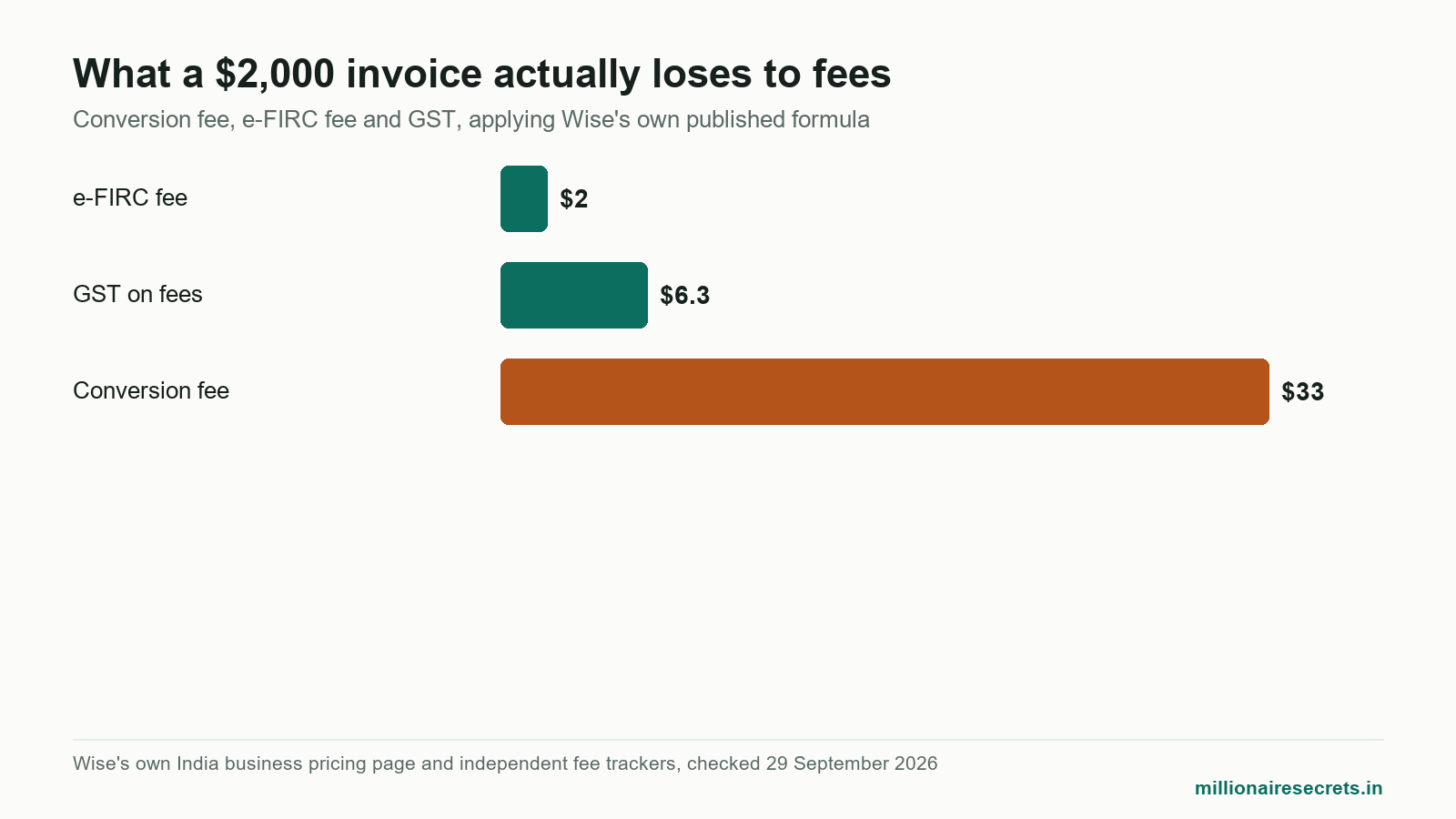
Applying Wise’s own GST formula, 18 percent of the conversion fee plus the e-FIRC fee, to three invoice sizes at a 1.65 percent conversion fee and the Rs 96 to the dollar mid market rate quoted by Wise’s own converter on 29 September 2026:
| Invoice | Conversion fee (1.65%) | e-FIRC fee | GST (18% of fee+e-FIRC) | Total fees | You receive |
|---|---|---|---|---|---|
| $500 | $8.25 | $2.00 | $1.84 | $12.10 | $487.90 (about Rs 46,839) |
| $2,000 | $33.00 | $2.00 | $6.30 | $41.30 | $1,958.70 (about Rs 188,035) |
| $5,000 | $82.50 | $2.00 | $15.21 | $99.71 | $4,900.29 (about Rs 470,428) |

On a $2,000 invoice, the fees come to a little over two percent once GST is stacked on top of the conversion fee and the e-FIRC charge, a detail every comparison site mentions in passing and none of them actually total for you against Wise’s own published GST rule. The GST line is the part almost nobody prices in, because it is calculated on the fee, not the invoice, so it looks small in isolation and only shows its real size once you add it to everything else.
Wise India fee calculator
Enter an invoice amount and a conversion fee percent, and this applies Wise’s own published GST formula: 18 percent of the conversion fee plus the e-FIRC fee. It is arithmetic on published rates, not a quote from Wise.
The e-FIRC fee is fixed at 2 dollars per Wise’s own help page. GST is 18 percent of the conversion fee plus the e-FIRC fee, per Wise’s own India business pricing page. This is not advice about your own tax position.
Is GST really added on top of Wise’s fee?
Yes, and Wise’s own India business pricing page states it directly: GST is 18 percent of the conversion fee plus the e-FIRC fee. It is not charged on your invoice amount, which is the confusion that sends people looking for a GST calculator when a fee calculator is what they actually need. Agar aapka client USD mein pay kar raha hai to GST sirf Wise ki fee par lagta hai, poori invoice par nahi, lekin fee ke upar fee lagne se total thoda aur badh jaata hai. Separately, whether you need to register for GST at all depends on your own turnover crossing the threshold, and our guide to when that Rs 20 lakh threshold actually applies covers it in full, separate from the LUT route that lets you invoice foreign clients without adding 18 percent IGST once you are registered.
What do recent reviews say about getting your money out?
The fee math is only half the risk. We read Wise’s own Trustpilot page for recent, dated accounts of money actually getting stuck, since a correct fee calculation means nothing if the transfer itself does not clear. Two recent reviews, neither from India specifically, describe the pattern worth knowing before you rely on Wise as your only channel. A reviewer identified as Valentyna Hrushkevych, posting on 28 September 2026, reported her account restricted since 20 August 2026, with support sending what she called repetitive instructions that never addressed the actual problem, still unresolved after 39 days. A reviewer identified as Sheila Muschamp, posting on 9 September 2026, reported a disputed refund on fraudulent card charges of 3,797 pounds, where Wise’s own message about the refund did not match money actually landing in the account.
Neither account is India specific and neither is about GST, FIRA or a freelance invoice directly, so treat them as evidence of a platform wide review and restriction pattern rather than anything unique to Indian freelancers. We also read a widely shared Indian competitor’s blog post warning Indian freelancers specifically about Wise account freezes; it carried no dated example, named case or verifiable incident behind the warning, only a hypothetical scenario, and it closed by recommending its own product, so it is named here as a source we checked and rejected, not one we are relying on. Where the two verified accounts agree with each other: a restriction, once triggered, runs into weeks rather than days, and Wise’s own support responses were described as generic rather than case specific in both.
Is Wise India better than PayPal, Payoneer or a local alternative?

That comparison is its own page rather than a paragraph here, because a fair answer needs the same fee math run against PayPal and Payoneer’s own pricing, not a summary. Our PayPal vs Payoneer vs Wise comparison for Indian freelancers carries that full breakdown. What belongs here instead is the one fact that comparison cannot repeat often enough to matter on its own: every one of the three platforms issues some form of the same FIRA or eFIRA certificate your bank and your GST filing both expect, so choosing between them is a question of fees and reliability, not of which one lets you skip the paperwork. Our own breakdown of what a $1,000 invoice costs through Payoneer runs the same kind of worked calculation this page runs for Wise, if you want the two placed side by side on one invoice size.
Frequently Asked Questions
Frequently asked questions
Does Wise India charge GST on the full payment I receive or just on Wise’s fee?
Just Wise’s fee. Wise’s own India business pricing page states GST as 18 percent of the conversion fee plus the e-FIRC fee, not a percentage of your invoice amount.
How long does the e-FIRC actually take to arrive?
Wise’s own help article for Indian businesses describes it as issued automatically for every transfer; third party guides commonly cite two to seven days after the transfer completes, which is a reasonable window to plan around when a client or auditor asks for it.
Can I use a personal Wise account to receive freelance payments?
No, not by design. Wise’s own business receive money page frames the receiving product specifically for a small business or freelancer, which means Wise Business, not Wise Personal, is the account to open before your first invoice, whatever the exact status of personal accounts turns out to be.
What is the maximum I can receive in one transfer through Wise India?
Industry reporting on Wise’s RBI in principle approval as a cross border payment aggregator puts the inbound limit at up to Rs 25 lakh per transfer, roughly $29,000 to $30,000 at recent rates. A milestone payment larger than that needs a different route or splitting across transfers.
Does Wise India charge a lower conversion fee at higher volumes?
Wise’s own pages do not publish a volume discount tier for India, unlike some competitors that advertise lower rates above a monthly threshold. If your monthly foreign income is large and consistent, that is worth checking against Wise’s calculator directly rather than assuming the standard fee applies at every size.
What happens if Wise flags my account for review?
Based on the dated reviews read for this article, expect the process to run into weeks rather than days once triggered, with support responses that can feel generic rather than specific to your case. Respond with every document requested as completely as possible on the first reply, and keep a second payment channel available for anything urgent while a review is open.
Finished the page? The same five questions from the top, to see what stuck.
Platform rules and rates change without notice. This page was verified in September 2026 and is rechecked on the Sunday refresh. If you hit something different, tell us in the comments and we will update it.

Leave a Reply