
Data sell karke paise kaise kamaye poochne wale zyadatar logon ko yeh nahi pata ki yeh apps unka mobile data plan nahi bechti, balki unka internet connection kisi aur ki traffic route karne ke liye kiraye par deti hain. Honeygain aur Pawns.app real paisa dete hain, lekin jo bikta hai woh ek proxy connection hai, na ki koi data package.
Listen to this article, about 8 minutes. A synthetic voice reads the article and announces each section title as it begins; tables are read row by row and the questions at the end are left out.
Recorded 1 October 2026 from the article as published that day. Press a chapter to jump there; the highlighted line is what is playing. A play button sits beside every section heading, and once you scroll past this player a bar at the bottom of the screen keeps the controls in reach. Tap or click any sentence to hear the reading start from there.
On this page: what Honeygain’s and Pawns.app’s own policies actually say your connection is used for, the payout math that shows what IPRoyal resells your bandwidth for, an FBI alert naming this exact app category, and why three names pushed by YouTube videos have no public terms at all.
Think you already know this? Five questions, one minute.
Every answer is on this page. Answer from what you know now; the page fills in the rest.
-
1. Honeygain aur Pawns.app asal mein kya bechti hain?
Dono apps aapka recharge ya data pack nahi bechti. Woh aapke internet connection ka ek hissa, jab woh idle ho, kisi paying client tak route karti hain. Honeygain’s payout page isi model par kaam karta hai. Read the section
-
2. According to Honeygain’s own privacy policy, what does joining its network involve?
Honeygain’s own privacy policy, applicable since 11 September 2023, states that joining its network means you willingly share your device’s internet traffic with Honeygain and its clients. Read the section
-
3. Pawns.app pays $0.20 per GB shared. What does IPRoyal, the proxy network that bandwidth feeds, list as its own residential proxy price per GB?
IPRoyal’s own residential proxy sourcing page lists pricing starting from $1.75 per GB, roughly eight times the $0.20 Pawns.app pays the person who shared it. Read the section
-
4. What pattern did multiple dated Trustpilot reviews from late September 2026 describe?
Reviewers on both Honeygain’s and Pawns.app’s Trustpilot pages, dated 24 to 28 September 2026, described being banned close to a withdrawal point. Both companies attribute this to automated fraud checks, not a stated policy. Read the section
-
5. The FBI’s IC3 alert of 12 March 2026 named which route as one way criminals enrol devices into residential proxy networks?
The IC3 alert, dated 12 March 2026, names apps that promise to pay people for their internet bandwidth as one of five enrolment routes into residential proxy networks. Read the section
The distinction matters. Selling a mobile data plan and renting out your IP address to an unknown client are two completely different things, and none of the YouTube videos ranking for this query explain the difference. This article carries real numbers from the two apps’ own terms, a clear warning about the three unverified names those videos push, and the one thing no other ranking page states.
Data sell karke paise kaise kamaye, yeh sach mein kaam karta hai?
Yes, two real apps work this way: Honeygain and Pawns.app. Both are listed on the Play Store and the App Store, both have paid actual users, and both publish their payout terms. But “selling data” is the wrong name for what happens. Neither app sells your mobile recharge or a data pack. They route a slice of your internet connection, while it sits idle, to a paying third party client instead.
What that means in practice: your phone or laptop, while it stays online, becomes a small exit point that another company uses to reach the internet through your connection.
What are these apps actually selling?
Honeygain’s own privacy policy states it plainly: becoming a part of Honeygain’s network means you willingly share your device’s internet traffic with Honeygain and its clients, and the company discloses your location and IP data to business partners so they can access and collect data from public web resources. That policy has applied since 11 September 2023.
Pawns.app’s model is even more direct. IPRoyal, a proxy provider with more than 64 million IPs in its pool, states on its own residential proxy sourcing page that it sources residential IPs through two channels, one of them Pawns.app: users share their internet bandwidth, and their devices become proxy endpoints added to the network. Yehi mechanism har Data Hub style app ke peeche kaam karta hai, chahe app khud isse kuch bhi bulaye.

How much do Honeygain and Pawns.app actually pay, and what do they keep?
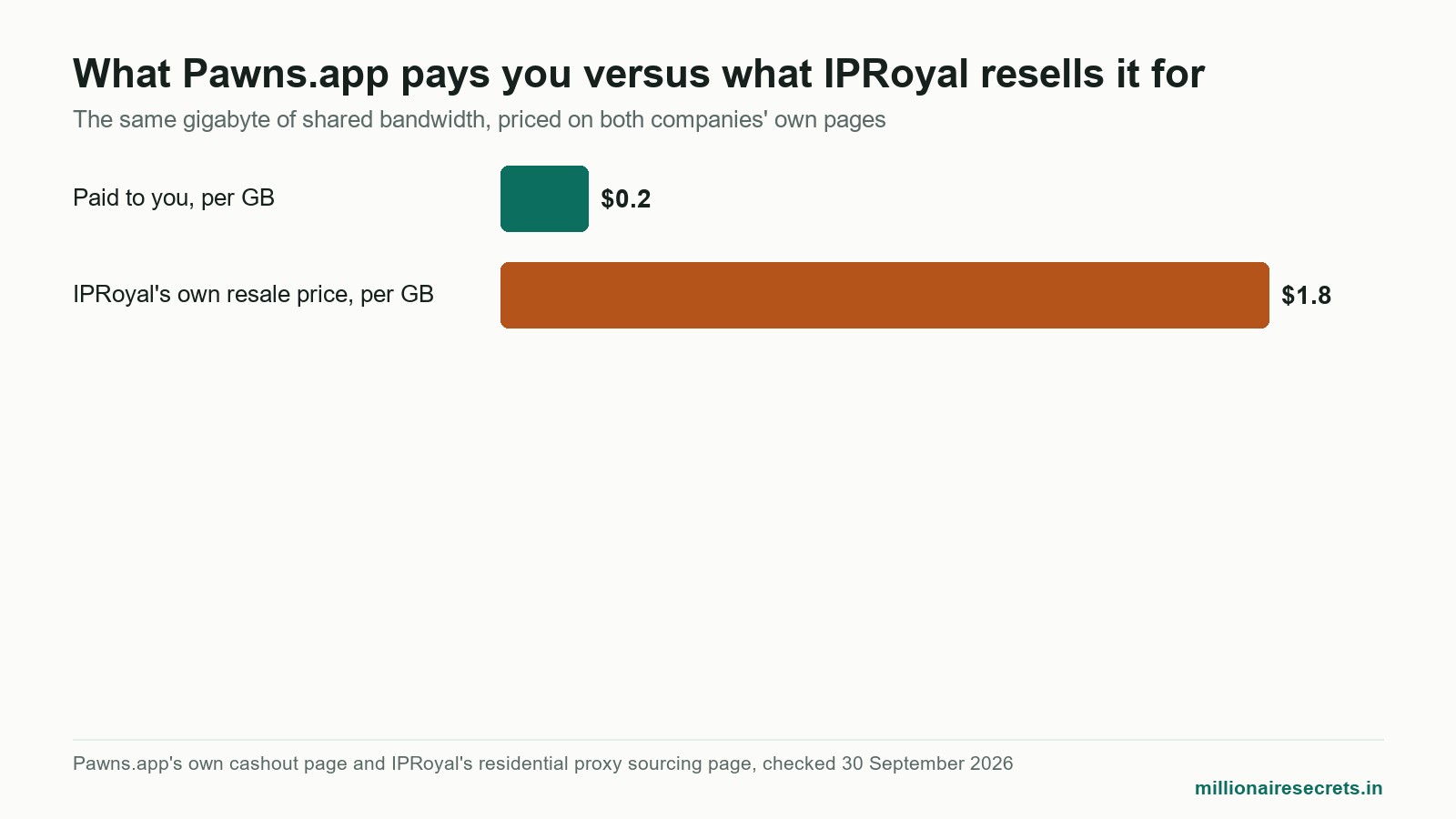
Here is where the arithmetic gets interesting. Pawns.app pays $0.20 per gigabyte of bandwidth you share, straight from its own cashout page. IPRoyal, the proxy network that bandwidth feeds, lists residential proxy pricing starting from $1.75 per gigabyte on its own site. That is roughly eight times what you were paid for the same gigabyte, before IPRoyal’s own client even negotiates a bulk rate down from that list price.
| App | What it actually does | Minimum payout | What it pays, per its own pages |
|---|---|---|---|
| Honeygain | Shares your device’s internet traffic and IP address with the company’s business partners and clients | $20 (or about $1 if you route the payout through JumpTask) | $10 per 10,000 credits; 10 MB shared earns 1 credit |
| Pawns.app | Feeds your connection into IPRoyal’s residential proxy pool as a paid proxy endpoint | $5 | $0.20 per GB shared, per IPRoyal’s own sourcing page |
Honeygain’s $20 minimum looks small until you do the maths on how much idle bandwidth a typical Indian home connection can realistically contribute while still leaving enough for actual browsing, streaming or a video call. Neither company’s own page states a typical monthly earning figure, which is itself worth noticing: every third party blog ranking for this query quotes a number Honeygain and Pawns.app do not put in writing themselves.
There is also a real difference in what device the bandwidth comes from. Some reports say Pawns.app’s passive WiFi Share only runs on the Windows and Mac apps now, with the mobile app left for surveys and games; other pages still describe it working on phones. We could not settle which is current from Pawns.app’s own help pages, so the honest answer is to check the app’s current settings screen yourself before assuming a phone alone will get you anywhere near $5. Honeygain, by contrast, confirms on its own site that it runs on both WiFi and mobile data, with a setting to cap how much cellular data it uses, which matters if your plan is not unlimited.
None of this changes who the buyer actually is. A market research firm, an ad verification client or a scraping operation pays IPRoyal or Honeygain for access through your connection, and neither company is required to tell you which client used your IP on a given day. That gap, between what the apps disclose in their policies and what a reader actually finds out about a specific use, is the part every YouTube video promising easy money from unused data skips entirely.
What do people who actually used these apps report?
Dated reviews on Trustpilot, read for this article on 30 September 2026, show a pattern worth knowing before you install anything. A Honeygain user named Sami Mahmoud reported on 26 September 2026 that his account ran normally until his balance reached close to $11 through JumpTask, Honeygain’s payment partner, after which an automated system banned him, just under the $20 line. On Pawns.app’s own review page, a user called Jawad Rayce reported on 24 September 2026 that his account was disabled a few days after he started, right after reaching an early $5 balance, with no explanation beyond a generic message. A reviewer called Chantal reported a similar block on 28 September 2026 after what she described as ordinary use, with no appeal process offered.
That is three accounts, all from the same week, all describing a suspension that arrived close to a withdrawal point. It is not universal. Pawns.app’s own review page also carries users who report fast PayPal payouts with no issue, and both companies frame the bans as automated anti fraud checks rather than a deliberate policy. We read Honeygain’s Trustpilot page and Pawns.app’s Trustpilot page for this section; what people report is testimony, not proof that either company times its bans on purpose, but the pattern is common enough that anyone signing up should screenshot their balance along the way.
Data Hub, Net Cash 2.3 aur Data Cash Pro ka kya, jo video mein push kiye ja rahe hain?
We could not find verifiable publisher information, a help page or terms of service for any of these three names, while both Honeygain’s and Pawns.app’s policies are public and readable. That absence is itself a warning: a business model you cannot read an explanation of is not one you can evaluate, whether it turns out to be an outright scam or just a badly documented clone. A genuine bandwidth sharing app, of the kind shown above, writes down its pricing and its data partners in public, because that disclosure is its actual legal basis.
Every video ranking for this exact query pushes these three names with referral links attached, without stating what access the app requests. The FBI’s Internet Crime Complaint Center issued an alert on 12 March 2026 naming “passive income schemes” specifically as one route criminals use to enrol devices into residential proxy networks: proxy services convince people to download applications that promise to pay them for their internet bandwidth, which means a criminal client can use that connection too, without the device owner ever knowing.

Practical rule: agar koi app apna data use publicly likh kar explain nahi karti, jaise Honeygain aur Pawns.app dono karte hain, to uspe bharosa mat kijiye, chahe video kitna bhi confident kyun na lage. Our own guide to spotting fake earning apps leads with exactly this check.
For readers weighing whether the legitimate two are worth it at all: our breakdown of which earning app categories are actually real and the wider honest guide to paise kaise kamaye online both cover what pays better for the same hour of attention, without handing your connection to a stranger’s client.
What is this app actually asking for?
Pick what an earning app’s permission screen or terms mention, and see what that access is usually worth to a buyer.
This sorts a permission request into a known pattern. It does not promise any earning amount and is not a judgement on any specific app.
Frequently asked questions
Kya Honeygain aur Pawns.app se paisa sach mein aata hai?
Haan, dono apps ne verified users ko paisa bheja hai: Honeygain $20 minimum par, Pawns.app $5 minimum par. Lekin paisa aapke mobile data plan ke liye nahi, aapke internet connection ko ek proxy endpoint ke roop mein share karne ke liye milta hai.
Is this the same as selling my mobile data or my recharge balance?
No. Nothing here touches your telecom data pack. These apps share your device’s internet bandwidth with business clients while your connection is idle, which is a different resource from the data you pay your telecom operator for.
Kya mera IP address kisi ke illegal kaam ke liye use ho sakta hai?
FBI ke IC3 alert ke mutabik, residential proxy networks ka istemal fraud, scraping aur account takeover jaise kaamon ke liye hota hai, aur us traffic ka IP address wahi hota hai jiska connection use hua, matlab aapka. Dono companies apne clients ko screen karne ka daava karti hain, lekin guarantee nahi de sakti.
Why did my Honeygain or Pawns.app account get banned right before payout?
Multiple Trustpilot reviewers from late September 2026 described exactly this pattern on both apps. Both companies attribute it to automated anti fraud checks rather than a deliberate policy, but it is common enough that tracking your balance with screenshots is worth doing.
Data Hub, Net Cash 2.3 ya Data Cash Pro jaisi apps safe hain kya?
Hum in apps ke liye koi verifiable publisher information ya privacy policy nahi dhoond paaye, jo apne aap mein ek warning sign hai. Jab tak app apna data use publicly explain nahi karti, uspe apna connection dena risky hai.
What is a residential proxy, in plain terms?
A residential proxy lets someone else’s internet traffic appear to come from your home connection and your real IP address, instead of a data centre. Apps like Honeygain and Pawns.app are two of the ways these networks recruit devices, according to both the companies’ own policies and the FBI’s IC3 alert.
Finished the page? The same five questions from the top, to see what stuck.
Platform rules and rates change without notice. This page was verified in October 2026 and is rechecked on the Sunday refresh. If you hit something different, tell us in the comments and we will update it.

Leave a Reply