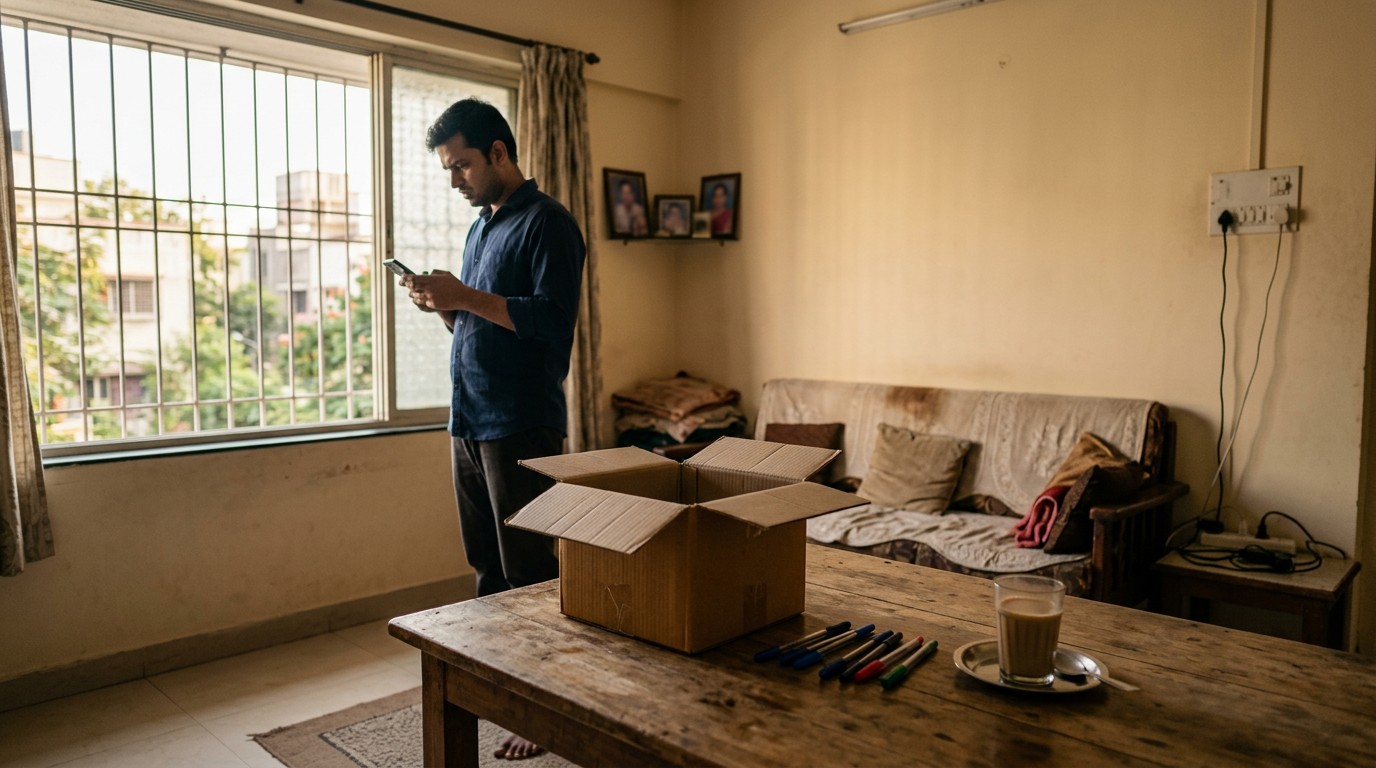
Packing jobs from home that start with a fee are a scam, however official the ID card looks. The Facebook versions using pencil and pen brands follow one script: a small registration fee, then delivery, GPS and deposit charges, and no material ever arrives. Genuine packing work pays you, and it never asks for money first.
Are packing jobs from home real or fake?
The work itself is real. Somebody, somewhere, puts agarbatti into boxes and pencils into packs. What is not real is the version that reaches most people: a sponsored post promising a steady monthly income for packing branded pencils at the dining table, with materials delivered to your door. That offer is not a job with a catch. The catch is the whole job.
The brand most often borrowed is Natraj, and the company has said so publicly. In an August 2023 notice, reported by Deccan Herald, Hindustan Pencils said it does not offer work from home packing jobs, has not authorised anyone to collect money in its name, and that its Natraj and Apsara pencils are made and packed on automated machinery in its own units. It also reported filing an FIR and getting 991 pages carrying the fake offer taken down. A company that owns packing lines has no reason to post boxes to your house so you can do slowly what its machines do in a second.
The fakes did not stop with that notice. In September 2024 The Quint’s fact check traced a viral video in which a senior Kanpur police officer appeared to advertise pencil packing jobs. The audio was AI generated over real footage, and police registered an FIR. Once the scam borrows the faces of the people warning you about it, the ad proves nothing.
How does the packing job scam take your money, step by step?
It never asks for a big sum up front. It asks for a small one, and then for a slightly bigger one that protects the first. Each fee comes with a reason that sounds like logistics, which is why sensible people keep paying. The ladder below is compiled from the accounts in the next section, with the source on every row.
| Stage | What the fee is called | Amounts people report | Where it is recorded |
|---|---|---|---|
| 1. The hook | Registration, joining or ID card fee | Rs 500 to Rs 1,000; Rs 620 appears again and again | ConsumerComplaints.in listing, r/Scams, July 2026 |
| 2. The paper | A certificate or ID card that looks official | Included, which is the point: it makes the next fee feel safe | r/Scams, July 2026 |
| 3. The dispatch | Delivery, GPS tracker, truck or material charge | Rs 2,000 to Rs 5,000 the next day; Rs 6,200 and Rs 15,000 in one complaint | r/Scams, complaint of March 2022 |
| 4. The deposit | Security deposit, “salary security”, insurance | Rs 2,500 in the same complaint; others list deposits of several thousand | Complaint of March 2022 |
| 5. The official sounding one | GST on goods, payment slip, clearance | Rs 12,500 GST and Rs 21,500 for a payment slip, then a Rs 25,000 demand that was refused | Complaint of March 2022 |
Notice what never appears anywhere on that ladder: a parcel. Stage five is the tell that the operation is running out of believable reasons. Nobody charges a packing worker GST on goods they have not received, and no employer bills you for the slip that records your salary.

What do people who paid for a packing job actually report?
We read the complaint entries filed against the Natraj name on ConsumerComplaints.in, more than 30 of them, dated September 2021 to February 2024; one full complaint in detail; a September 2023 post on Consumer Complaints Court; and a July 2026 thread on Reddit with its replies. Treat all of it as testimony, what people say happened to them, not a finding by a court or a regulator. The complaints are filed under the brand’s name, but what they describe is impersonation, and nothing in them shows the pencil company took anyone’s money.
The pattern across the listing is narrow. The first contact was most often a Facebook ad or a Facebook message, sometimes a phone call. The opening fee sat between roughly Rs 520 and Rs 750, and Rs 620 turns up so often it reads like a price list. The totals people reported losing mostly ran from that first few hundred rupees to around Rs 13,000. A handful of entries on the page are marked resolved, a status the site records, which does not tell you money came back.
The largest account we read in full is a complaint from New Delhi dated March 2022. The person found the offer on Facebook, moved to WhatsApp and phone calls, and paid in stages: Rs 750 to register, Rs 2,500 as a salary security deposit, Rs 6,200 to revive a delivery truck’s GPS, Rs 12,500 described as GST, Rs 15,000 for delivery and Rs 21,500 to prepare a payment slip. She put the total at Rs 79,149. When she refused a further Rs 25,000, the calls turned threatening, and she reports that a promised full refund never came.
The newest account is the shortest. In a July 2026 thread on r/Scams, someone in India described a Facebook pen packing ad before paying anything: personal details first, then a registration fee of Rs 500 to Rs 1,000, an official looking certificate, and a call the next day asking Rs 2,000 to Rs 5,000 to dispatch the material. They asked whether anyone had ever received work or pay. Not one reply said yes. One commenter asked the question worth keeping: why would a company pack pens, ship them to you, and pay you to pack them again?
One account cuts the other way, and it is the most useful of the lot. The September 2023 post on Consumer Complaints Court came from someone who messaged the Facebook poster, was asked for money straight away, recognised the pattern and paid nothing. The scam is not clever. It relies on people not stopping for thirty seconds.
Where the accounts and the official guidance agree: money requested before work is the whole scheme. Where they differ: the Ministry of Home Affairs job fraud brochure tells jobseekers not to apply to jobs posted on search engine ads, social media ads or sponsored links at all, and says no company ever asks for money to work for them. Most guides on packing jobs tell you to check whether the company is genuine. Every account here began with a social media ad, and checking the brand was no help, because the brand was genuine and had nothing to do with it.
Ghar baithe packing ka kaam: asli kaam kahan milta hai?
Asli kaam hota hai, bas woh Facebook ad se nahi aata. Most real packing work in India is on site: e-commerce warehouses, FMCG factories, and small units that pack incense, papad, spices or garments. Those roles come with a shift, a supervisor and a wage, and the hiring runs through the employer, a known staffing agency or a job portal.
Home based packing does exist, mostly through local contractors who hand out material in your own neighbourhood and pay by the piece. You can see the unit, meet the person, and walk away with the material in a bag rather than waiting for a truck with a broken GPS. Pay for that kind of work is modest, and anyone promising office salaries for it is selling the promise, not the work.
| Question | Real packing work | The Facebook packing job |
|---|---|---|
| Where you find it | A warehouse, factory or a local contractor whose unit you can visit | A social media ad or a WhatsApp forward with a mobile number |
| Who pays whom first | The employer pays you, after work is done | You pay them, before any material exists |
| What arrives first | Material, or a shift roster | An ID card, then a request for delivery money |
| Brand name used | Usually a contractor you have never heard of | A famous pencil, pen or incense brand |
| Promised pay | Piece rate or daily wage that sounds modest | Monthly figures that sound like an office job for sitting at home |
| What happens if you ask for a refund | Nothing to refund, you never paid | A new fee to “release” the refund, or silence |

If you do take up home based piece work, the government’s e-Shram portal lets home based and other unorganised workers aged 16 to 59 register, and its FAQ says registration is free, with no charge payable to anyone registering you. Keep that in mind the next time a stranger says a worker ID costs Rs 620. The same logic runs through the Rs 200 per page typing job offers and the data entry fee trap: change the product and the costume, and the fee remains the whole business model.
The expensive cousin asks for an investment instead of a fee: our page on online work for homemakers covers a 2026 Haveri packing scheme built on lakh rupee deposits, and the part time job scam checklist has every warning sign in one place.
Packing job ke naam par paisa de diya, ab kya karein?
Stop paying, whatever the next message says about refunds, penalties or legal action. Call 1930, the national cybercrime helpline, and file a complaint on the National Cyber Crime Reporting Portal. Report quickly, because a transfer can sometimes be held only in the first few hours. Keep the ad, the chat, every UPI reference and the numbers that called you. Tell your bank in writing.
If you have not paid but received the offer by call, SMS or WhatsApp, the Department of Telecommunications’ Chakshu facility on Sanchar Saathi takes reports of suspected fraud communication, and it sends anyone who has already lost money to 1930 and cybercrime.gov.in. Our walkthrough of how a cybercrime complaint actually runs covers what to expect after filing.
Be careful with anyone who contacts you afterwards offering to recover the money for a fee. That is a second scam aimed at people on the first scam’s list, and our page on getting money back after an earning app fraud explains which routes are official. This is general information, not legal advice.
Frequently asked questions
Does Natraj or Apsara give packing work from home?
No. Hindustan Pencils, which owns both brands, said in a public notice in August 2023 that it does not offer work from home packing jobs and has not authorised anyone to collect money for them. Its pencils are packed on automated machinery in its own factories.
Kya packing job ke liye registration fee dena normal hai?
Nahi. Koi bhi asli kaam dene wala aapse kaam shuru karne se pehle paisa nahi maangta. Registration fee, ID card charge, GPS ya delivery charge, security deposit, in sab ka matlab ek hi hai: yeh job nahi, fee collection hai.
Why do the fees keep increasing after the first payment?
Because the first fee is bait. Once someone has paid Rs 620, a Rs 2,500 delivery charge feels like protecting that money rather than risking more. Complaints describe fees for GPS, insurance, GST and payment slips, each justified as the last step before material arrives.
Is there any genuine home based packing work in India?
Some exists, mostly through local contractors who hand out material nearby and pay by the piece, and on site in warehouses and factories. Genuine work pays modestly, lets you meet the person or visit the unit, and never asks for a deposit.
Pencil packing ka video mein police officer bol raha tha, toh kya woh sach hai?
Nahi. September 2024 mein ek aisa viral video fact check hua tha jismein Kanpur ki ek police officer ki asli video par AI se banayi hui awaaz lagayi gayi thi. Police ne FIR bhi darj ki. Video mein koi bhi dikhe, fee maangne wala offer fake hi rehta hai.
Can I get my money back from a packing job scam?
Recovery is uncertain and depends mostly on how fast you report. Call 1930 and file on cybercrime.gov.in straight away, inform your bank in writing, and ignore anyone offering to recover the money for a fee, since that is usually a second fraud.
Platform rules and rates change without notice. This page was verified in September 2026 and is rechecked on the Sunday refresh. If you hit something different, tell us in the comments and we will update it.

Leave a Reply