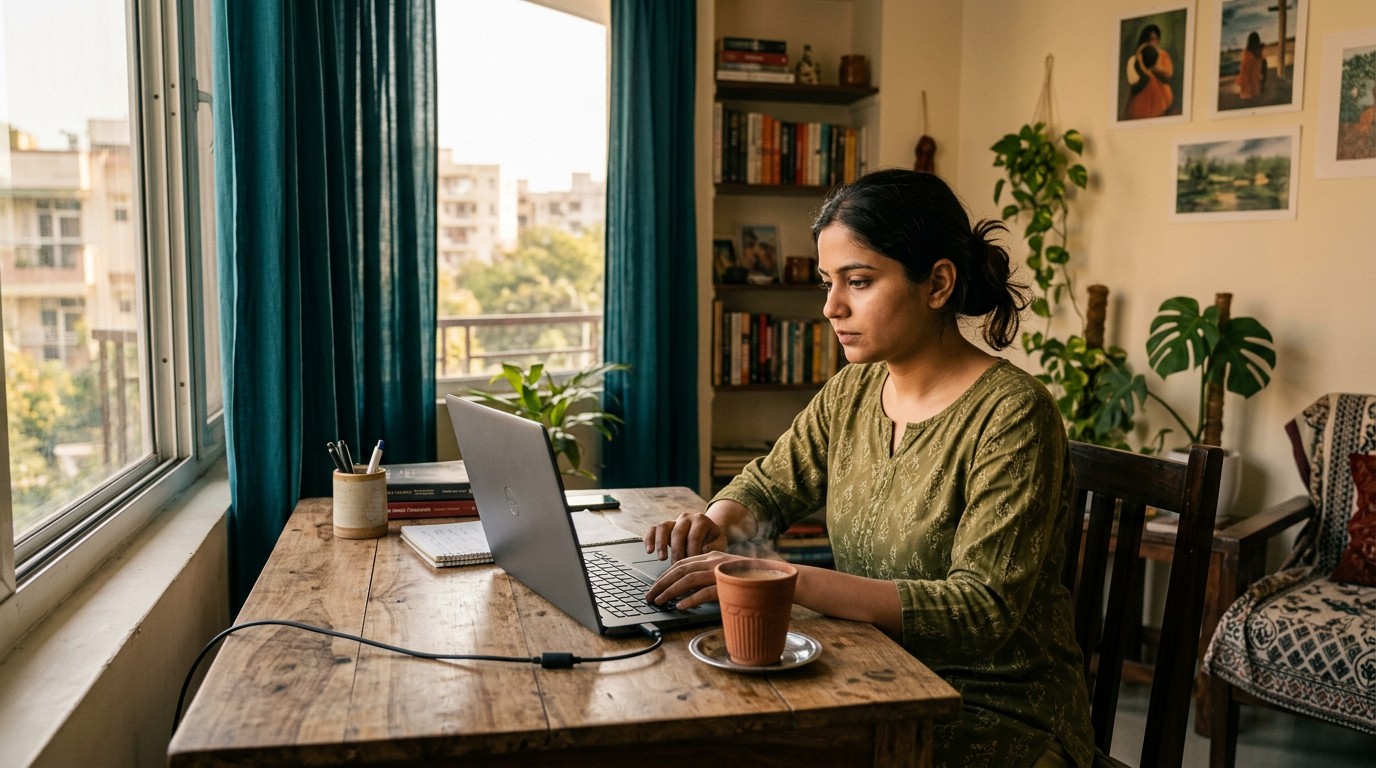
Work from home proofreading jobs that accept Indians exist, but fewer than the listicles claim. On 16 October 2026, Cactus (Editage) lists India based editor roles and ProofreadingServices.com takes applicants from any country, while Scribbr and ProofreadingPal are closed and several firms want native speakers. Every real one tests you. None charges you.
Listen to this article, about 11 minutes. A synthetic voice reads the article and announces each section title as it begins; tables are read row by row and the questions at the end are left out.
Recorded 16 October 2026 from the article as published that day. Press a chapter to jump there; the highlighted line is what is playing. A play button sits beside every section heading, and once you scroll past this player a bar at the bottom of the screen keeps the controls in reach. Tap or click any sentence to hear the reading start from there.
On this page: a table of what six proofreading platforms’ own careers pages say about Indian applicants, tests and pay, read on 16 October 2026, the per 1,000 word figures Cactus editors reported this year, and a chooser that matches your background to the platforms whose stated bar you plausibly clear.
Think you already know this? Five questions, one minute.
Every answer is on this page. Answer from what you know now; the page fills in the rest.
-
1. What did Scribbr’s application page say on 16 October 2026?
Scribbr’s application page said it was not hiring at the moment and offered a mailing list for when recruitment reopens. Read the section
-
2. Which firm in the table says you may apply from any country?
ProofreadingServices.com’s careers page says applicants are welcome from any country; ProofreadingPal’s route runs through US colleges or long editing experience. Read the section
-
3. What score moves you past Scribbr’s 10 question language quiz?
Scribbr’s quiz page says a score of 80 points or higher leads to the test assignment. Read the section
-
4. What range does Upwork give for its freelancer service fee?
Upwork’s pricing page describes a variable fee of 0% to 15%, fixed once a contract starts. Read the section
-
5. What does Cactus say about asking candidates for money?
Cactus’s contractor page says the company never requests any payment or fees from candidates at any stage of recruitment. Read the section
Which proofreading platforms actually accept applicants from India?
Most “top 15 proofreading jobs” pages are written for Americans and copied for everyone else, which is how an Indian reader ends up applying to a firm that wants a US university email address. So we went to each platform’s own careers page and wrote down what it says today, including the dull bits about who is allowed in.
| Platform | Who can apply, per its own page | The test | Pay it states | Open on 16 October 2026? | Source |
|---|---|---|---|---|---|
| Cactus Communications (Editage) | Subject specialists; roles titled “Work from home in India”; over 500 contract editors from 30+ countries | Online application with an editing test | Not stated; per assignment fee | Yes, subject roles listed | Cactus |
| ProofreadingServices.com | “Apply from any country” | 20 minute preliminary test | $19 to $46 an hour, by turnaround | Yes | ProofreadingServices |
| Wordvice | Extensive experience and an advanced degree; master’s or doctorate preferred | Sample editor test | Not stated | Listing live | Wordvice |
| Scribbr | Native English speakers; bachelor’s degree; 10,000 words a week | 10 question quiz, 80 points to pass, then assignments | Not stated on the application page | No, waitlist only | Scribbr |
| ProofreadingPal | US college graduate students or staff with a 3.5 GPA, or a graduate degree plus five years’ editing | Questionnaire, then a timed exam | “Typically” $500 to $3,000 a month | No, expects to reopen late fall 2026 | ProofreadingPal |
| Enago | Experienced native English editors | Not described on the pages we read | Not stated | Form live | Enago |
Two things stand out. First, the work that is most open to India is academic editing, not book proofreading: researchers who write in English as a second language pay to have papers polished before journal submission, and firms like Cactus hire subject experts to do it. Second, “open” changes month to month. Scribbr’s application page now says it is not hiring and offers a mailing list, and ProofreadingPal’s careers page says it is not accepting applications and expects to reopen in late fall 2026. A ranking page that tells you to apply there this week is simply out of date.
Does “native English speaker” rule out Indian applicants?
Sometimes, and the firms do not all mean the same thing by it. Scribbr says plainly that all its editors are native speakers and that it does not bend on this. Enago’s careers page says it recruits experienced native English editors. Wordvice is the confusing one: its editors page has been summarised as describing its team as native speakers from the US, Canada, the UK, Australia and New Zealand, while its freelance editor listing says its editors live and work all over the world and asks for experience and an advanced degree rather than a passport. We could not reconcile the two, so treat Wordvice as possible but uncertain.
Cactus is the exception that matters for Indian readers. It is an Indian company, its editor listings are titled work from home in India, and it hires by subject: its listings cover fields such as life sciences, medicine, engineering and economics, and ask for a degree in the field. If you are not sure your English is at that level yet, our honest look at how good your English needs to be for online work has a self test.

Which platforms’ stated bar do you plausibly clear?
Pick the line closest to your background. This matches you to what each platform’s own page asks for on 16 October 2026; it does not predict whether you will pass.
General information from each platform’s own page. Requirements change, so read the live careers page before you apply. Real platforms never charge you to apply.
What do the proofreading tests actually check?
Grammar rules you can name, not grammar you can feel. Scribbr’s quiz is 10 questions on specific editing rules and you need 80 points to move on to unpaid test assignments; it also wants you to manage 10,000 words a week. ProofreadingServices.com opens with a 20 minute preliminary test. ProofreadingPal follows a questionnaire with what it calls a comprehensive timed examination.
The pattern is the same everywhere: consistency, academic tone, commas that do a job, and catching the error you were asked about rather than rewriting the whole paragraph. Agar aapko comma aur semicolon ka farak samjhana pade, toh test se pehle practice kariye. Nobody publishes the answers, and a site selling “Scribbr test answers” is selling a ban.
What do Cactus editors actually report about pay and work?
Cactus is the platform most open to India, so it is the one worth hearing from. We read three r/Copyediting threads from May to October 2026 and about 25 replies from people who said they edit, review or used to work for Cactus; none said they were based in India, though one Indian reader asked about rates. These are what people report, not rates the company publishes.
The loudest theme was shrinking work. In the longest thread, started in May 2026, editors with six, eight and nine years on the platform described months of refreshing an empty assignment window; one said in October 2026 that September was mostly spent refreshing. A six year editor said they used to earn $1,000 to $1,500 a month and were down to about $600 by mid 2026, after a new contract around two years earlier that they read as a rate cut.
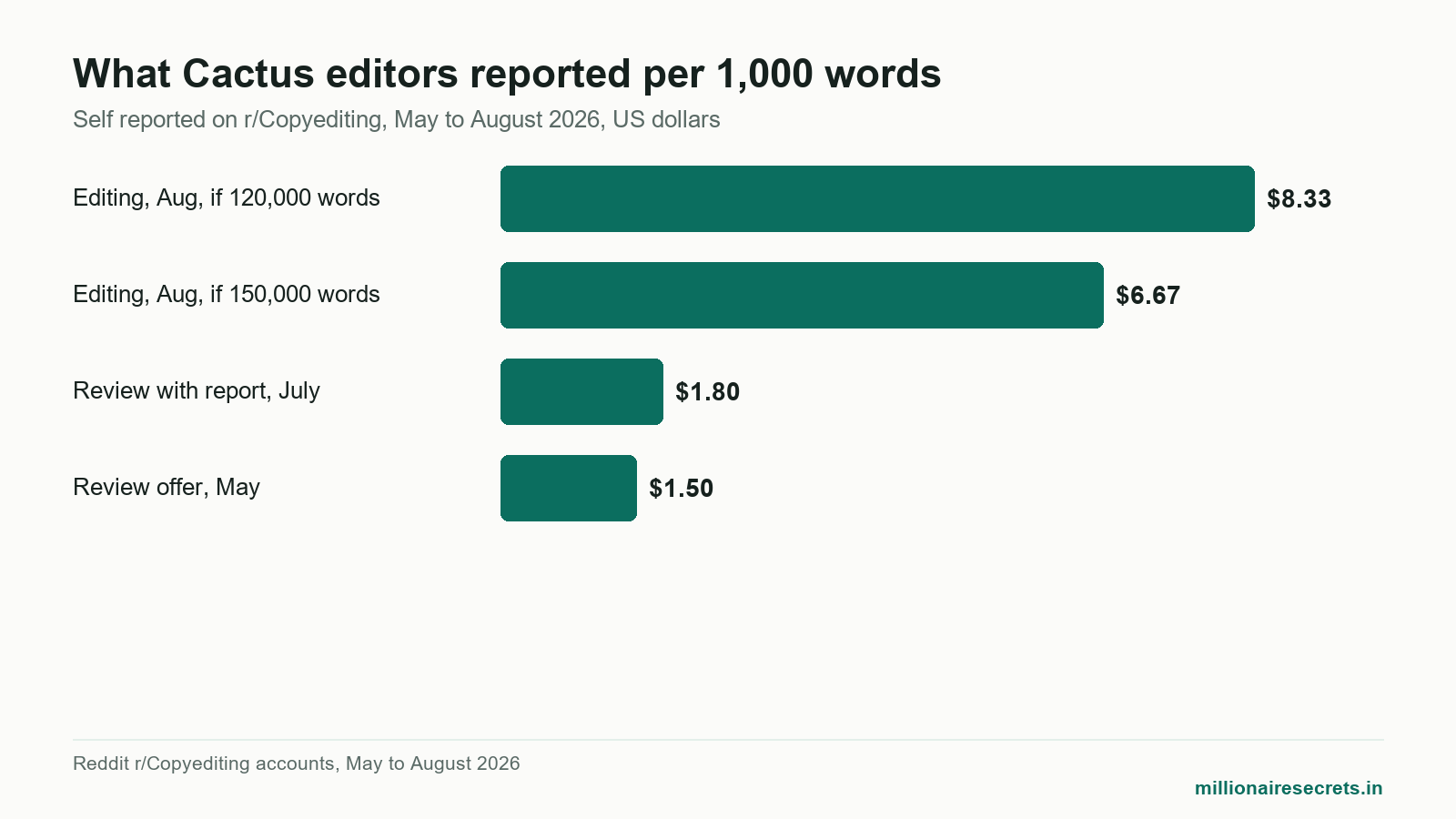
| What was reported | When | Works out to |
|---|---|---|
| At least $1,000 a month for 120,000 to 150,000 words edited | August 2026 | About $6.70 to $8.30 per 1,000 words |
| About $600 a month, down from $1,000 to $1,500 six years earlier | June and July 2026 | Not given per word |
| A reviewer offer of about $15 for 10,000 words | May 2026 | $1.50 per 1,000 words |
| $9 for 5,000 words plus a cover letter and a detailed editor’s report | July 2026 | $1.80 per 1,000 words |
Pay itself was the second theme. Several editors said rates are set by a dynamic system they cannot see, and that AI pre edited jobs leave them correcting the machine for less. In a May 2026 thread on reviewer roles, one person said they turned down a reviewer offer that worked out near $5 an hour. Payment, two editors said, goes through Payoneer in US dollars or rupees, and one former editor said those reliable monthly transfers were what made the work viable for years.
Not every reply was grim. Several said the flexibility is real and the work suits people who cannot do an office job, and in a May 2026 thread on alternatives another editor said Enago and Accdon pay about the same as Cactus while MPS, Charlesworth and Lumina Datamatics pay better. Where the accounts match the official pages: no fee to join, and payment by the job. Where they go further: the volume is not guaranteed and the AI era has cut both rates and workload.

How much does proofreading from India really pay after fees?
The only firm in our table that publishes an hourly figure is ProofreadingServices.com, at $19 to $46 an hour depending on turnaround, with the top rate for the most urgent jobs. ProofreadingPal says its editors typically earn $500 to $3,000 a month, but it is closed to new applicants.
On a freelance marketplace the fee comes off first. Upwork says its freelancer service fee is variable, from 0% to 15% a contract, fixed once the contract starts. A worked example with illustrative inputs: a $100 proofreading job at a 10% fee leaves $90, and the conversion spread when you withdraw to rupees comes off that. Compare the rupee amount that lands, not the headline rate; our guides to Payoneer and Wise show where the spread hides. If you go the marketplace route, landing the first Upwork client is the hard part, and freelance writing rates per word give a useful comparison.
Income tax still applies. Proofreading income from foreign clients is taxable for an Indian resident, and whether a presumptive scheme fits depends on whether your work counts as a specified profession; the Income Tax Department’s ITR-4 FAQ lists those professions, and our page on Section 44ADA for freelancers goes further. This is general information, not advice: confirm your own position with a chartered accountant.
Proofreading job ke liye registration fee dena padta hai kya?
No. Cactus says on its contractor page that it never asks candidates for payment at any stage of recruitment, and none of the firms in our table charges to apply. The fee schemes look different: a WhatsApp or Telegram message offering book proofreading at a fixed rate per page, then a “security deposit”, then a “commission” before your first payout. Our page on freelance writing jobs records one such proofreading case that asked for Rs 2,700 and then Rs 4,780 more.
If someone asks for money before giving you work, stop and do not pay. Do not send your Aadhaar, PAN or bank details to an unverified recruiter. If you have already paid, call 1930, India’s cyber fraud helpline, straight away, because a quick report gives the bank the best chance of holding the money.
Is proofreading still worth learning when AI checks grammar?
For simple grammar fixes, the market has already moved. Our look at what content writing pays in India cites research showing a fall in new contracts for text heavy freelance work after generative AI arrived, and the Cactus accounts above say the same thing from the inside. What still sells is judgement: subject knowledge, journal style, and catching what the software confidently got wrong. Proofreading ab sirf typo pakadna nahi raha. If you have a degree in a technical field, academic editing is the realistic way in; if you do not, build a few sample edits and start on a marketplace. Our list of skills that pay Indians on global platforms puts it beside the alternatives.
Frequently asked questions
Can Indians apply to Scribbr as proofreaders?
Scribbr says it works only with native English speakers, and on 16 October 2026 its application page said it was not hiring and offered a waitlist instead.
Kya proofreading job ke liye degree chahiye?
Most firms in our table ask for at least a bachelor’s degree. Wordvice prefers a master’s or doctorate, and Cactus hires by subject, so a science degree can help.
Which proofreading company is based in India?
Cactus Communications, which runs Editage, is an Indian company that lists work from home editor roles in India by subject area.
How long is the ProofreadingServices.com test?
Its careers page says the preliminary test takes 20 minutes. It does not publish a pass mark.
Proofreading ka paisa India mein kaise aata hai?
Cactus editors report payment through Payoneer in dollars or rupees. Marketplace work is withdrawn through the platform, Payoneer or Wise, each with a conversion spread.
Is proofreading income taxable in India?
Yes, for a resident it is taxable income. Whether a presumptive scheme applies depends on your work; confirm with a chartered accountant.
Finished the page? The same five questions from the top, to see what stuck.
Watch the 39 second summary
The video covers the takeaways of this guide in under a minute. More summaries are on Millionaire Secrets Dot IN on YouTube.
Platform rules and rates change without notice. This page was verified in October 2026 and is rechecked on the Sunday refresh. If you hit something different, tell us in the comments and we will update it.
Leave a Reply