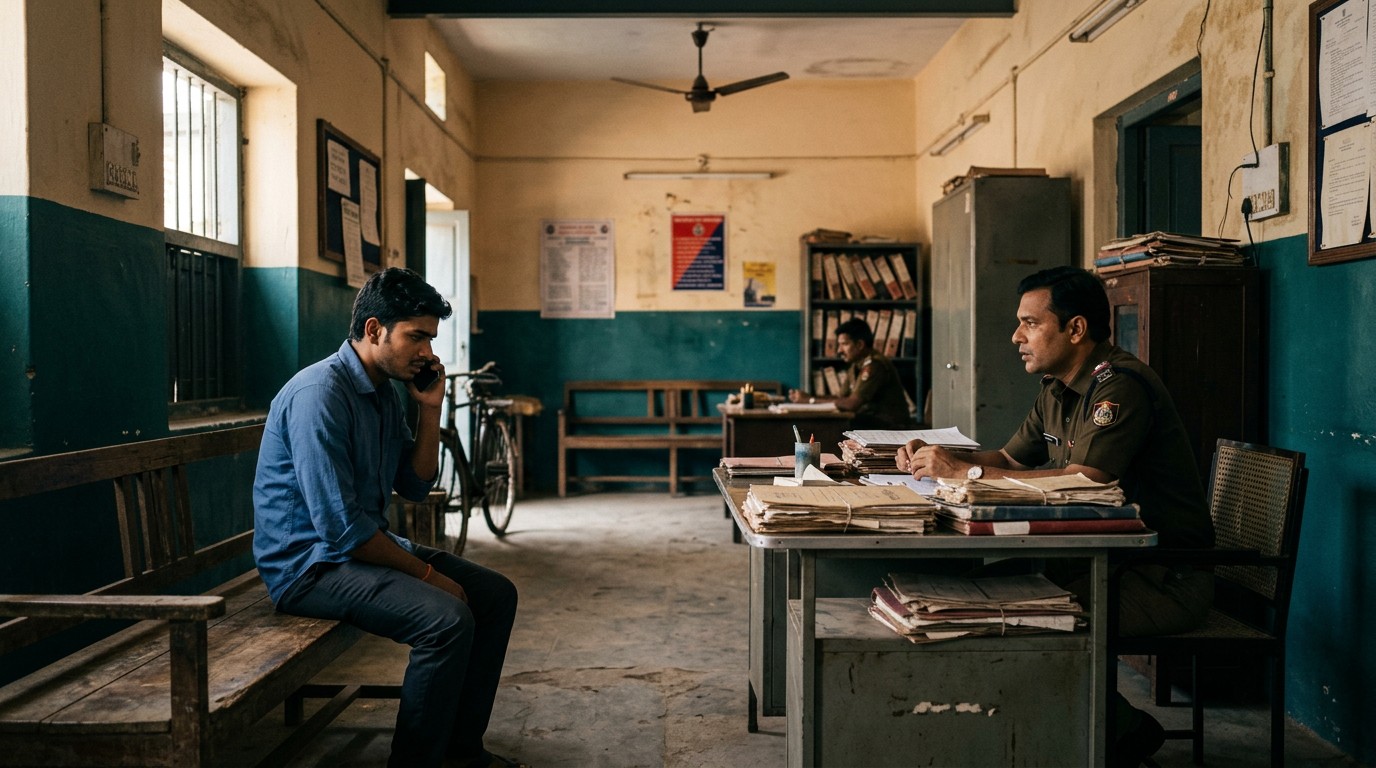
A FIR for cyber crime is not your 1930 call or your cybercrime.gov.in complaint. Those are complaints. An FIR is registered by a police station under BNSS section 173, and in 18 states and UTs a large fraud complaint now becomes an e-Zero FIR automatically, which you must sign at the police station within three days.
Listen to this article, about 14 minutes. A synthetic voice reads the article and announces each section title as it begins; tables are read row by row and the questions at the end are left out.
Recorded 28 September 2026 from the article as published that day. Press a chapter to jump there; the highlighted line is what is playing. A play button sits beside every section heading, and once you scroll past this player a bar at the bottom of the screen keeps the controls in reach. Tap or click any sentence to hear the reading start from there.
On this page: the home ministry’s own state by state count of 12,257 e-Zero FIRs laid before the Lok Sabha on 28 July 2026, the Rs 50,000 line in the 2026 fraud SOP that decides when you need an FIR to get held money back, and what victims report about getting one registered.
Think you already know this? Five questions, one minute.
Every answer is on this page. Answer from what you know now; the page fills in the rest.
-
1. Information about an offence given by electronic communication is taken on record as an FIR when?
BNSS section 173(1) says electronic information is taken on record on being signed within three days by the person giving it. The acknowledgement number is only your complaint reference. Read the section
-
2. Who decides the loss threshold above which a complaint becomes an e-Zero FIR?
The home ministry’s reply to Lok Sabha starred question 135 says the threshold is decided by the respective State or UT. Rs 10 lakh was the Delhi pilot’s starting figure in May 2025. Read the section
-
3. Which two places account for most of the e-Zero FIRs in the ministry’s July 2026 count?
Delhi had 6,115 and Chandigarh 4,174 of the 12,257 listed in the MHA statement of 28 July 2026, about 84 percent between them. Read the section
-
4. Under the 2026 home ministry SOP, amounts on hold above what figure are released in connection with an FIR?
Process 1 of the MHA SOP dated 2 January 2026 allows interim custody below Rs 50,000 under BNSS section 106(3), and above Rs 50,000 in connection with an FIR. Read the section
-
5. If a police station refuses to record your information, where does BNSS section 173(4) let you send it?
Section 173(4) lets the aggrieved person send the substance of the information to the Superintendent of Police, who must investigate or direct an investigation if a cognizable offence is disclosed. Read the section
Most people assume the acknowledgement number on their screen is an FIR number. It is not, and the difference decides whether a frozen amount above Rs 50,000 can come back to you and whether your bank takes the complaint seriously.
Checked on 28 September 2026 against the home ministry’s reply to Parliament, the BNSS text and the 2026 fraud SOP. If you have just lost money, call 1930 or file at cybercrime.gov.in first, then come back. Speed beats paperwork in the first hours.
Is a cybercrime.gov.in complaint the same as an FIR?
No. The National Cyber Crime Reporting Portal and the 1930 helpline record a complaint and route it to your state police and to the banks involved, so money can be put on hold quickly. An FIR is a separate legal record. Section 173(1) of the Bharatiya Nagarik Suraksha Sanhita says information about a cognizable offence can be given orally or by electronic communication, but electronic information is taken on record only once the informant signs it within three days. Section 173(2) adds that you get a copy of the recorded information free of cost.
The portal itself treats the two as different stages: its FAQ says a financial fraud complaint can be withdrawn only before it is converted into an FIR. Our guide to what the acknowledgement number tracker shows explains the statuses you will see while you wait.
| 1930 or portal complaint | e-Zero FIR | Regular FIR at a police station | |
|---|---|---|---|
| Who creates it | You, by phone or online | The system, automatically, above your state’s loss threshold | The officer in charge of a police station |
| Legal basis | Complaint on the NCRP and CFCFRMS | BNSS section 173(1), registered at the state e-Crime police station | BNSS section 173(1) |
| What you must do | Report fast, keep the acknowledgement number | Visit the assigned cyber police station within three days to convert it | Give information, sign it, take your free copy |
| Can you withdraw it online | Yes, before it becomes an FIR | No | No |
| Unlocks release of held money above Rs 50,000 under the SOP | No | Yes, once converted | Yes |
When does a 1930 complaint become an FIR automatically?
That is the e-Zero FIR. A Press Information Bureau release announced it in May 2025 as a Delhi pilot: fraud complaints above Rs 10 lakh on the portal or 1930 would automatically become a Zero FIR at Delhi’s e-Crime police station. Delhi Police later cut its own threshold to Rs 1 lakh from 1 November 2025, as the Tribune reported.
By July 2026 the design had changed in one important way. The ministry’s reply to Lok Sabha starred question 135 on 28 July 2026 says the loss threshold is decided by each state or UT, the e-Zero FIR is registered at that state’s e-Crime police station, and it is then transferred to the territorial cyber crime police station. So the Rs 10 lakh most explainers still quote was the Delhi pilot’s starting number, not a national rule. We found no official list of state thresholds, so ask your state’s cyber police.
Which states run e-Zero FIR, and how many have been filed?
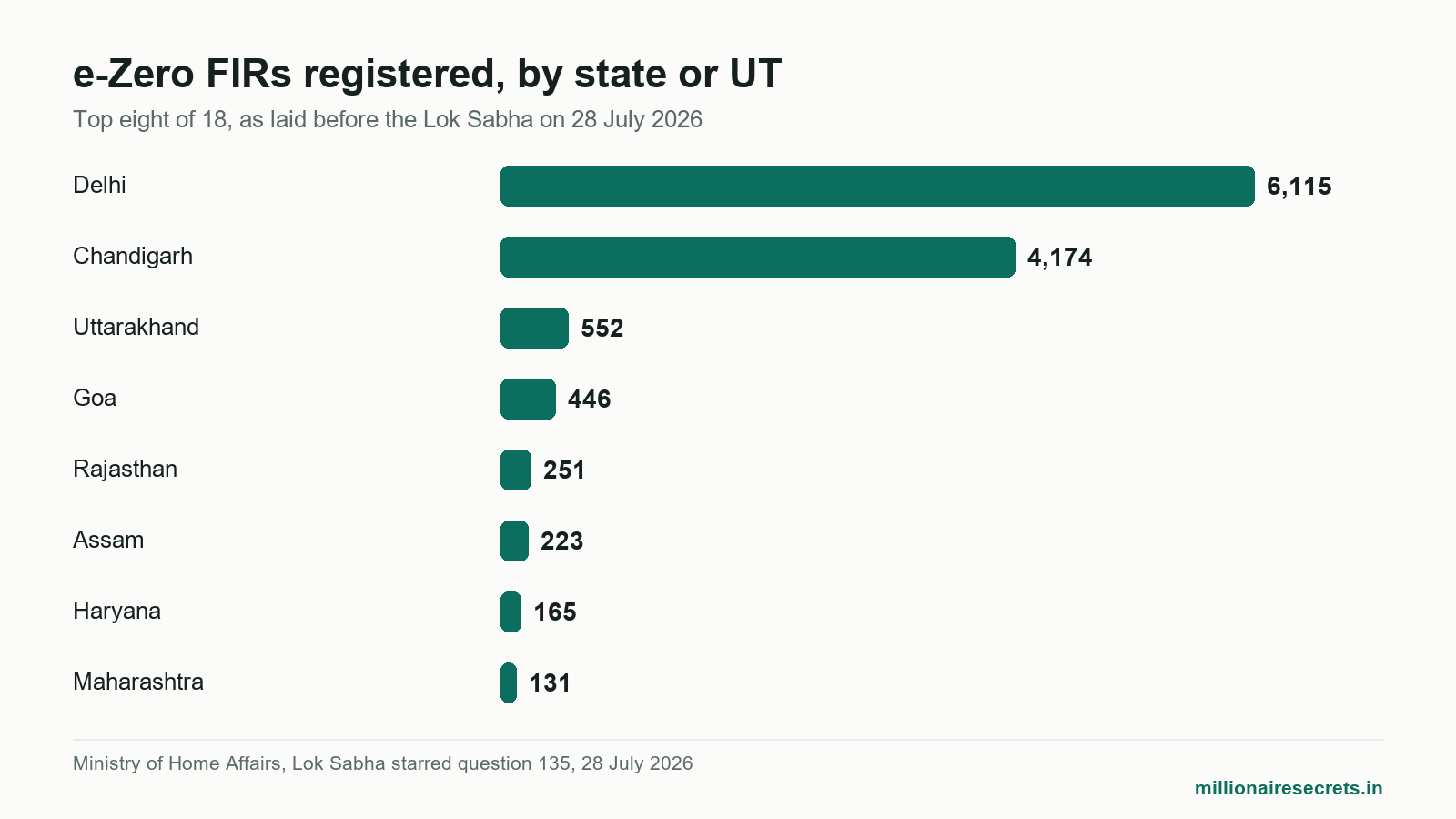
Here is the ministry’s own count, laid before the Lok Sabha on 28 July 2026, and the only official state wise figure we found.
| State or UT | Started | e-Zero FIRs | Source |
|---|---|---|---|
| Delhi | May 2025 | 6,115 | LS Q135 |
| Chandigarh | November 2025 | 4,174 | LS Q135 |
| Uttarakhand | March 2026 | 552 | LS Q135 |
| Goa | January 2026 | 446 | LS Q135 |
| Rajasthan | January 2026 | 251 | LS Q135 |
| Assam | June 2026 | 223 | LS Q135 |
| Haryana | June 2026 | 165 | LS Q135 |
| Maharashtra | July 2026 | 131 | LS Q135 |
| Madhya Pradesh | November 2025 | 61 | LS Q135 |
| Jammu and Kashmir | July 2026 | 39 | LS Q135 |
| Tripura | July 2026 | 32 | LS Q135 |
| Odisha | June 2026 | 27 | LS Q135 |
| Bihar | July 2026 | 12 | LS Q135 |
| West Bengal | June 2026 | 10 | LS Q135 |
| Telangana | July 2026 | 9 | LS Q135 |
| Tamil Nadu | July 2026 | 8 | LS Q135 |
| Gujarat | July 2026 | 1 | LS Q135 |
| Andaman and Nicobar Islands | July 2026 | 1 | LS Q135 |
| Total, 18 states and UTs | 12,257 | LS Q135 |
Two places, Delhi and Chandigarh, account for 10,289 of the 12,257, about 84 percent. Gujarat and the Andaman and Nicobar Islands had one each, and nine states had switched the system on only in July 2026, so their small numbers mostly reflect a few weeks of operation. A week later the government told the Supreme Court the mechanism was working in 19 states, as ThePrint reported on 4 August 2026, so expect the list to keep growing. If your state is missing, your complaint will not turn into an FIR by itself, whatever the amount.
What happens in the three days after an e-Zero FIR?
The ministry’s reply is plain: the complainant must visit the police station within three days to convert the Zero FIR into a regular FIR, matching the signature rule in section 173(1). Take all of this, because a second trip is the delay fraudsters count on:
- The NCRP acknowledgement number and the SMS or email saying an e-Zero FIR was registered
- Your bank statement showing each debit, with the UTR or transaction reference numbers
- Screenshots of chats, call logs, payment requests, the app or website, and any fake documents
- Photo ID, and the mobile number and email you gave the portal
- A short written timeline: date, time, amount, and what you were told at each step

Once the FIR exists, BNSS section 193(3), reproduced in the ministry’s SOP, requires the police to inform you of the progress of the investigation within 90 days. That is a right worth writing down, not a courtesy to wait for.
What to carry for the three day FIR visit
Tick each item as you put it in the folder, so one trip to the cyber police station is enough.
Ask for your free copy of the FIR before you leave; BNSS section 173(2) gives you that right.
Do you need an FIR to get frozen money back?
It depends on the amount, and this is where the FIR stops being paperwork. The home ministry’s SOP for NCRP, CFCFRMS and restoration of money, dated 2 January 2026 and adopted by the Uttarakhand High Court on 18 June 2026, sets out Process 1 for a single victim: interim custody of an amount below Rs 50,000 put on hold can be given under BNSS section 106(3), while amounts above Rs 50,000 are released in connection with an FIR.
The same SOP lists six High Courts that told their trial courts not to insist on an FIR for complaints already on the portal: Himachal Pradesh (26 March 2024), Punjab and Haryana (7 June 2024), Madras (1 July 2024), Guwahati (4 October 2024), Calcutta (10 March 2025) and Sikkim (1 July 2025). In those states a court can release held money on the portal complaint plus a police action taken report. Elsewhere, an FIR is often the practical key.
There is also a clock. Under the SOP, if an account holder contests a hold and the bank receives no lawful direction to continue it within 90 calendar days, the bank can lift the hold after telling the police. An FIR with an active investigating officer is what produces that direction. For the rest of the recovery route, see how to recover money lost to an earning app.

Police FIR likhne se mana kare toh kya karein?
It happens, and the law has a ladder for it. First, section 173(3) lets the officer in charge, with a DSP’s prior permission, hold a preliminary enquiry of up to 14 days for offences punishable with three years or more but less than seven years. That is a delay the law allows, not a refusal, so ask for it in writing.
If the station simply will not record it, section 173(4) lets you send the substance of the information in writing and by post to the Superintendent of Police, who must investigate or direct an investigation if a cognizable offence is disclosed. After that, a magistrate can order an investigation under section 175(3), but only on an application backed by an affidavit and a copy of what you sent the SP, as SCC Online’s analysis of section 175(3) sets out. Keep postal receipts. Sabse zaroori baat: har step ka proof rakhiye.
What do cyber fraud victims report about getting an FIR?
We read three sets of records published between July and September 2026: a national survey, a press account built from it, and a High Court order. Treat these as what people report, not as a measure of what will happen to you.
- Status of Policing in India Report 2026, released 24 September 2026 by Common Cause and Lokniti CSDS from a survey of 8,306 people in 16 states. Of 15 cyber crime victims who approached the police, FIRs were registered in only six, two of them automatic FIRs, and at least two of the others needed the victim to reach a person of influence, ETV Bharat reported. About 42 percent of complainants said registration was difficult.
- A victim who lost over Rs 14 lakh, described by Moneylife on 25 September 2026, reports that the bank would not register a complaint until an FIR was filed, and once it was, said the customer had collaborated with the fraudster. The case needed the RBI Ombudsman and a magistrate’s order, and a Rs 4.9 lakh consumer claim was still pending.
- Madras High Court, W.P. (Crl.) No. 6 of 2026, decided 15 July 2026: an online trading fraud where an FIR was registered under BNS section 318(4) and IT Act section 66D. The order records Rs 59 lakh already recovered and credited to the petitioner, with recovery of the rest continuing.
The pattern is less tidy than the rules. The survey says getting an FIR at all is the hard part; the Rs 14 lakh account shows that even with one, the bank pushed back until an ombudsman and a magistrate stepped in; the Madras order is the version where an FIR led to recovery. The survey covers 15 victims and the Madras case is one order, so none of this is a success rate. What the accounts add is the order of events: banks often want the FIR first, which makes the three day visit the step to protect.
If the fraud came through a job offer or a task app, our pages on the Telegram task scam and mule account job offers explain why the money moves through several accounts within minutes. The full reporting sequence, 1930 first, is in our guide to reporting online fraud.
This page is general information about Indian criminal procedure as published by the government, not legal advice for your case. For a large loss, a lawyer or your district legal services authority can help with the SP and magistrate steps.
Frequently asked questions
Is the NCRP acknowledgement number an FIR number?
No. It is the reference for your complaint on the portal. An FIR number comes from a police station once the information is recorded under BNSS section 173, and you are entitled to a free copy of it.
Cyber crime ki FIR online ho sakti hai kya?
Partly. BNSS section 173(1) allows information by electronic communication, but it is taken on record only after you sign it within three days. In states running e-Zero FIR, a large enough portal or 1930 complaint is registered as an FIR automatically, and you still visit the station to convert it.
Is there a minimum amount for a cyber crime FIR?
Not for a regular FIR: any cognizable offence can be reported. The loss threshold applies only to the automatic e-Zero FIR, and the home ministry says each state or UT sets its own. Delhi started at Rs 10 lakh and moved to Rs 1 lakh from 1 November 2025.
What if I miss the three day window after an e-Zero FIR?
Go to the assigned cyber police station as soon as you can with your acknowledgement number and documents, and ask in writing what is needed to complete the FIR. The official material we read does not say what happens after day three, so do not assume it lapses quietly.
Kya FIR ke bina bank paisa wapas karega?
Under the 2026 home ministry SOP, an amount below Rs 50,000 on hold can be released without an FIR, while larger amounts are released in connection with an FIR. Six High Courts have also told trial courts not to insist on an FIR for complaints already on the portal.
Can I withdraw my cyber complaint after an FIR?
Not through the portal. Its FAQ says a financial fraud complaint can be withdrawn only before it is converted into an FIR. After that, what happens to the case is a matter for the police and the court.
Finished the page? The same five questions from the top, to see what stuck.
Platform rules and rates change without notice. This page was verified in September 2026 and is rechecked on the Sunday refresh. If you hit something different, tell us in the comments and we will update it.

Leave a Reply