
Telecalling jobs work from home are real, but the honest version is a small slice of what gets advertised. Genuine employers hire home based telecallers and pay a modest fixed salary plus incentives. They never charge you. The trap is the placement consultancy that takes a registration fee, and a TRAI rule almost nobody mentions.
Listen to this article, about 11 minutes. A synthetic voice reads the article and announces each section title as it begins; tables are read row by row and the questions at the end are left out.
Recorded 10 October 2026 from the article as published that day. Press a chapter to jump there; the highlighted line is what is playing. A play button sits beside every section heading, and once you scroll past this player a bar at the bottom of the screen keeps the controls in reach. Tap or click any sentence to hear the reading start from there.
On this page: a comparison table of telecalling routes, regulatory facts from TRAI, reported fee figures from public complaints, and a checklist to spot genuine offers.
Think you already know this? Five questions, one minute.
Every answer is on this page. Answer from what you know now; the page fills in the rest.
-
1. How many live work from home telecalling listings did Internshala carry on 18 September 2026?
On 18 September 2026, the Internshala work from home telecalling page carried 75 live listings from named companies. Read the section
-
2. According to TRAI guidance, what can happen to a personal phone connection used to send promotional messages on the first complaint?
According to the Telecom Regulatory Authority of India, a personal connection used for commercial calls is liable for disconnection on the first complaint. Read the section
-
3. What is the application fee policy stated on the TP careers page?
The TP careers page states that the company will never ask you to pay money during the application process for equipment or in exchange for employment. Read the section
-
4. What is the range of fees reported across the dated public complaints against consultancies?
Public records, such as the QuickJobzz record on Consumer Complaints, show reported fees ranging from Rs 500 to Rs 20,160. Read the section
-
5. Which national helpline should you call immediately to report online financial fraud?
If you lose money to a scam, you should immediately call 1930 to report it to cybercrime.gov.in. Read the section
Are telecalling jobs work from home actually real?
Yes, and that is worth saying plainly, because a lot of writing on this topic treats the whole category as a scam. On 18 September 2026 the Internshala work from home telecalling page was carrying 75 live listings from named companies, with stated pay of roughly 2 lakh to 5 lakh a year. Large contact centre employers run home based programmes too. So the category exists.
What makes it messy is that the same three words cover four different things: a real employer hiring a remote telecaller, a big BPO running a work at home shift, a placement consultancy selling you access to jobs, and a WhatsApp group that wants you to call strangers off a spreadsheet using your own SIM. Only two of those are jobs. The same borrowed brand trick runs at the biggest name of all, and our check of Amazon work from home jobs in India found the exact job title returning zero openings on Amazon’s own board. If you would rather type than talk, our check of which BPOs list chat support work from home roles today covers the non voice side.
What does TRAI say about calling from your own number?
This is the part that almost never appears in a telecalling jobs listicle, and it is the one that can cost you something you actually need. The listings themselves deserve the same care, and what applicants report about Indeed work from home jobs in India shows how the fee staircase looks when it arrives as a job board listing.
Commercial calling in India is regulated. Under the framework the Telecom Regulatory Authority of India sets out for senders of commercial communication, a business that wants to make promotional contact has to register as a principal entity, register its headers and content templates, and collect consent through a registered template. An individual sitting at home with a personal SIM is none of those things.
TRAI guidance on unsolicited commercial communication, checked on 18 September 2026, is blunt about what happens then. If a consumer uses their telephone connection to send promotional messages, that connection is, in TRAI’s words, liable for disconnection on the first complaint, and the name and address may be blacklisted for two years.
Now read that against the offer. “Aapko bas apne phone se calls karni hain, leads hum denge” is not a generous arrangement. It puts the regulatory exposure on your number instead of the company’s registered infrastructure, which is presumably why they are not using theirs. A real employer either gives you a dialler and a registered line, or the calls are inbound and the question does not arise. The Meesho version of the same offer arrives with a joining fee attached, and our page on Meesho work from home jobs sets Meesho’s own careers guidance against two police records of how the money leaves.
Real employer, consultancy or commission trap: how do they compare?
| Route | How it reaches you | What it pays | What it costs you |
|---|---|---|---|
| Direct employer listing | You apply on a job board and get interviewed | Roughly 2 lakh to 5 lakh a year quoted as CTC across the 75 listings live on Internshala on 18 September 2026 | Nothing |
| Large BPO work at home programme | Company careers page, formal onboarding | Fixed monthly salary, shift bound, equipment usually provided | Nothing. The TP careers page states the company will never ask you to pay money during the application process for equipment or in exchange for employment |
| Placement consultancy | They call you first, usually about a bank job | Nothing until placed, and in the complaints we read, nothing after | Rs 500 to Rs 20,160 across the dated public complaints described below |
| Commission only, your own SIM | WhatsApp or Telegram group, no interview | Commission, on a target you are unlikely to reach | Your phone connection, which TRAI says is liable for disconnection on a first complaint |
Kitna paisa milta hai, honestly?
Here is where the advertised number and the bank statement part company, so it is worth doing the arithmetic once.
Take a listing quoting 3 lakh CTC. Salary aggregators tracking Indian telecaller pay through 2026 put fixed monthly pay for a fresher at roughly Rs 10,000 to Rs 18,000, with work from home roles clustering around Rs 10,000 to Rs 22,000 fixed. Put Rs 15,000 a month against that 3 lakh headline: that is Rs 1,80,000 of fixed pay in a year. The remaining Rs 1,20,000 is incentive, which works out to Rs 10,000 a month that arrives only in the months you hit target. Miss target for a quarter and the three lakh job is a Rs 15,000 job. If you are weighing telecalling against other first jobs, our guide to work from home jobs for freshers compares the remote roles that hire without experience and what each hirer asks for on its own page.
Nothing dishonest is happening there, as long as the split is stated up front. The warning sign is a listing that quotes only the CTC and goes quiet when you ask what the fixed component is. Ask before you accept, in writing, and ask what the target actually is in calls or conversions per day. If nobody will put that in an email, you have your answer.
What do people who paid actually report?
We read 37 dated complaints across four public consumer complaint records to see what the fee version of this looks like from the inside. These are accounts, not findings. They are what individuals say happened to them, and we could not independently verify any single one of them.
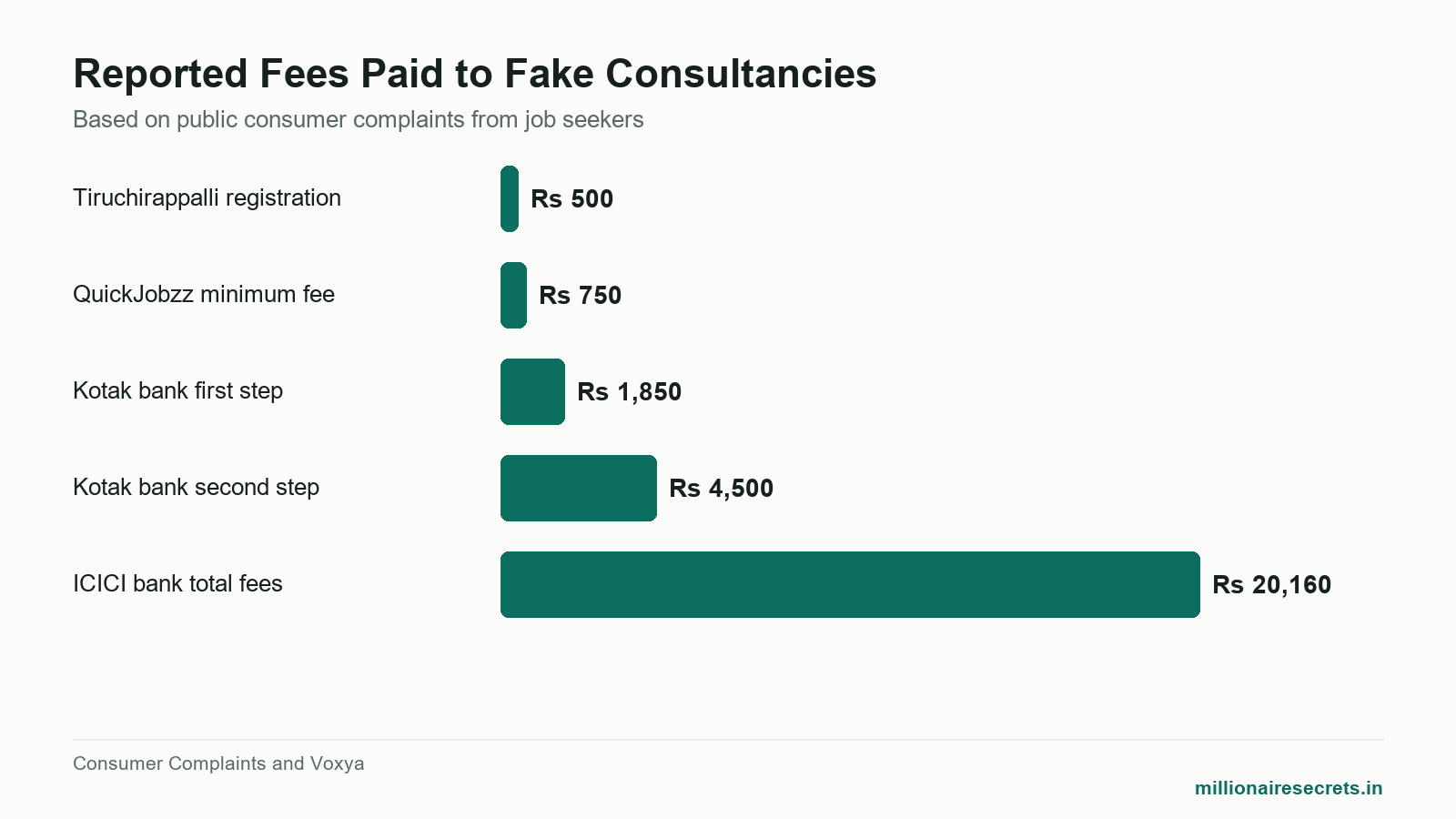
- The QuickJobzz record on Consumer Complaints carries 15 dated entries between November 2017 and June 2023. Amounts run from Rs 750 to Rs 20,160. The shape repeats almost mechanically: a small registration fee first, then a verification fee, then a record making fee, each framed as the last step before a bank back office role that never materialises.
- One complainant on that page, writing in February 2022, describes paying Rs 1,850, then Rs 4,500, then Rs 9,960 against a promised Kotak Mahindra Bank position. Another, in May 2019, describes four payments totalling Rs 20,160 against a promised ICICI Bank back office role.
- The Voxya fake job offer category was showing 20 complaints dated between March 2024 and June 2026. The recent cluster is cruise ship recruitment rather than telecalling, but the mechanism is identical: registration fee, then a medical fee, then silence.
- A 2016 complaint against a Tiruchirappalli consultancy describes Rs 500 for registration, then Rs 800 for foreign listings, then over Rs 1,000 for resume building, and six months of “HR is not available”. It is marked resolved, but the platform’s own note says the complaint was annulled because the author could not be reached. That is an administrative outcome, not a refund.
- A 2022 Voxya complaint describes the other pattern, the task and recharge version, where money goes in to unlock a withdrawal that never unlocks. Status: open, and the company shows zero resolved complaints.
Two honest caveats. The range is not uniform: one of the 37 was marked resolved, though only on a technicality, and most of the telecalling adjacent complaints sit in 2021 and 2022 rather than this year, so this is a pattern with history rather than a live outbreak. And here is the finding that surprised us. Almost nobody complains about being charged for a telecalling job specifically. What they describe is paying a consultancy that promised to place them, and in most of these accounts the whole thing began with an unsolicited phone call. In this category the telecalling is usually what is being done to the reader, not offered to them.

What does a genuine offer look like?
Most of this can be checked before you spend an hour on an interview. A real offer clears all six, not four.
- No money moves from you to them. Not registration, not training, not a refundable deposit for a headset, not a software licence. The employer’s own careers page usually says this outright.
- The company has a name you can search, a registered address, and a careers page listing the same role.
- The offer states a fixed monthly figure separately from incentive, in writing.
- Calling happens on the company dialler or a company provided line, not your personal SIM.
- There is an interview with a person, not a two minute WhatsApp exchange and an offer letter PDF.
- Your PAN and bank details are asked for at onboarding, after an offer, and never in the first conversation.
For the broader version of that checklist, our guide to part time work from home in India covers the categories that survive scrutiny, and the walkthrough of the data entry work from home fee scam documents the same fee ladder in the category where it is most common. The pen and paper version of the same trap runs through handwriting jobs from home, where five dated case records show the deposit being kept on a handwriting fault. If voice work appeals but cold calling does not, remote customer service roles are the inbound cousin of this job and are generally better paid.
Genuine Telecalling Offer Checklist
Use this checklist to verify if a work from home telecalling offer is legitimate before sharing your personal details.
Ticks are saved on this device only.
Kya karein agar paise chale gaye?
Act the same day. Speed is close to the only real variable in whether money is recoverable.
- Call 1930, the national cyber crime helpline, and file at cybercrime.gov.in under the financial fraud category. Early reporting is what allows banks to attempt to freeze the receiving account before the money is layered away.
- Keep every screenshot, UPI reference, call log and PDF. Do not delete the WhatsApp thread out of embarrassment. It is evidence.
- If no money was lost and it was only a suspicious call or message, report it through the Department of Telecommunications Sanchar Saathi fraud reporting facility, which asks for reports within 30 days and directs anyone who has actually lost money to 1930 instead.
- Tell your bank in writing, not only on a call, and keep the acknowledgement.
Our step by step guide to reporting online fraud in India covers what happens after you file, including how to follow the acknowledgement number. If you are building towards something steadier than telecalling, the online income ladder for India sets out which rungs actually connect to the next one.
One last thought. Every one of us has been interrupted mid meal by a stranger offering a personal loan nobody asked for. That call exists because somebody was hired to make it, usually on a fixed component of about Rs 15,000 a month. Working out which side of that call gets paid, and which side pays for it, is most of what you need here.
Frequently asked questions
Are telecalling jobs work from home real or fake?
Both exist. Named employers hire home based telecallers and large contact centre companies run work at home programmes, so the category is real. The fake version is a placement consultancy that charges a registration fee for access to a job that never appears.
Telecalling job ke liye koi fee deni padti hai kya?
Nahi. A genuine employer never charges for registration, training, verification or equipment. The TP careers page states the company will never ask for money during the application process. Any fee request, however small and however refundable it is said to be, ends the conversation.
Can I do telecalling work from my own mobile number?
For outbound promotional calling this is risky. TRAI guidance says a personal telephone connection used to send promotional messages is liable for disconnection on the first complaint, with the name and address blacklisted for up to two years. A genuine employer provides a registered line or dialler.
What salary do work from home telecallers actually get in India?
Salary aggregator data through 2026 puts fixed pay for a fresher telecaller at roughly Rs 10,000 to Rs 18,000 a month, and work from home roles at about Rs 10,000 to Rs 22,000 fixed. Listings quoting 2 lakh to 5 lakh a year are usually quoting CTC including incentives.
Telecalling aur customer support mein kya farak hai?
Telecalling is usually outbound: you call people who did not ask to be called, and pay is tied to conversions. Customer support is usually inbound: people call you with a problem. Inbound work is generally better paid and less target driven, though it more often carries fixed shift timings.
What do I do if a telecalling job consultancy took my money?
Call 1930 and file at cybercrime.gov.in the same day under financial fraud, keep every payment reference and message, and inform your bank in writing. Speed matters because banks can only attempt to freeze the receiving account before the money moves on.
Finished the page? The same five questions from the top, to see what stuck.
Platform rules and rates change without notice. This page was verified in September 2026 and is rechecked on the Sunday refresh. If you hit something different, tell us in the comments and we will update it.

Leave a Reply