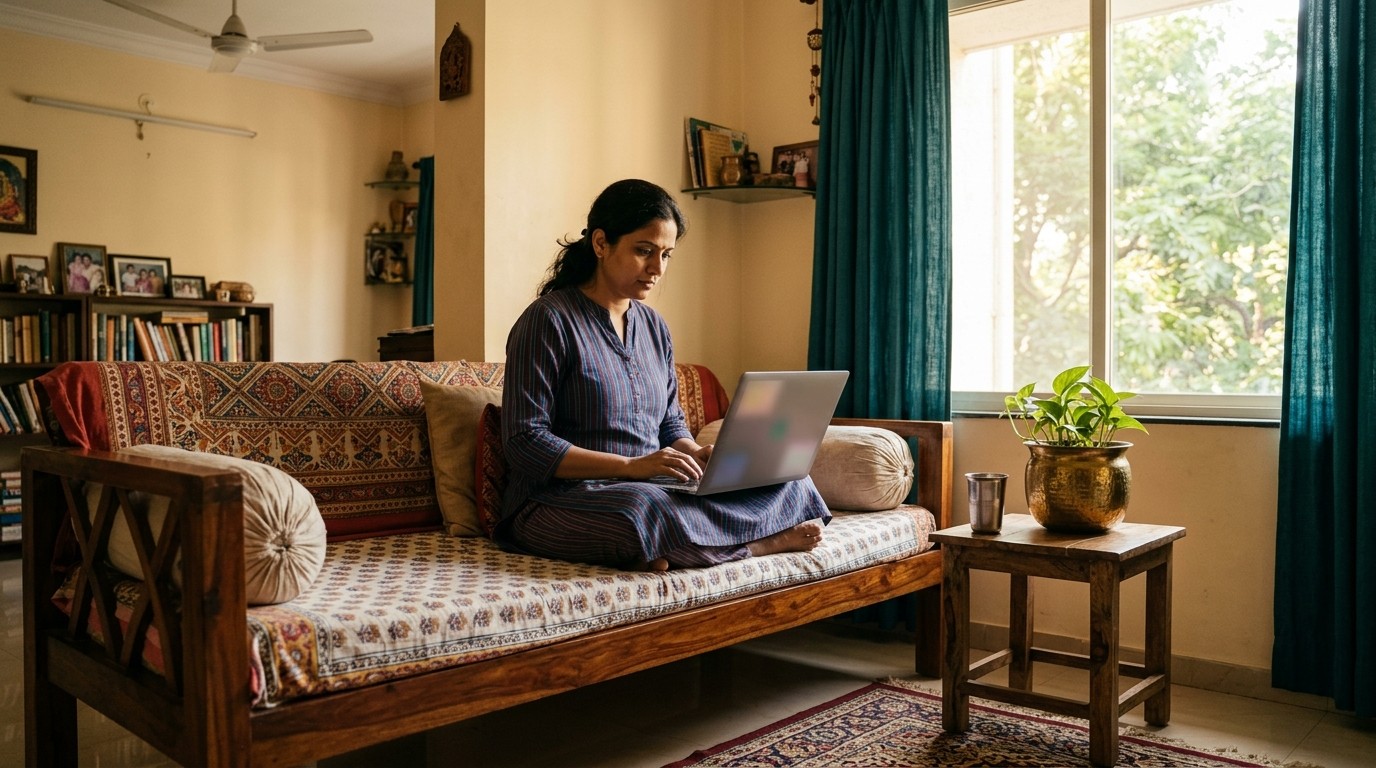
Online work for housewives in India pays steadily rather than spectacularly. Expect roughly Rs 8,000 to Rs 25,000 a month for genuine part time hours, once you have a PAN and a bank account in your own name. Your earnings are your own income, and anything charging a joining fee is not work.
Which online work is realistically open to a homemaker?
The honest filter is not what you are good at. It is what a stranger will pay for without meeting you, and what survives an interrupted afternoon. That rules out most of the roles these listicles promise and leaves a shorter, more useful list.
| The work | What it actually needs | Realistic pay | The catch nobody mentions |
|---|---|---|---|
| AI training and search rating | Comfortable written English, a laptop, and passing an unpaid assessment | TELUS Digital advertises about 8 dollars an hour for India based raters | Work arrives in project waves and can stop with no notice |
| Online tutoring | A subject you can teach and a quiet hour, not always a B.Ed | Roughly Rs 250 to Rs 400 an hour starting out on platforms, more for direct students | The hours are evenings and weekends, which is when the house needs you |
| Freelance writing, design or admin support | A small portfolio of real samples, which you can make yourself | Varies enormously, and the first three months are the lean ones | Finding the first client is the whole job at the start |
| Reselling and social selling | A phone, a network, and patience with returns | Margins are thin and depend entirely on your own contacts | Sold as passive. It is sales, and sales is work |
| Data entry and form filling | Advertised as needing nothing at all, which is the tell | Almost always nothing | This category is overwhelmingly a fee scam, not an industry |
Two of these have full write ups already: our review of TELUS Digital rater work from India covers the assessment and the pay, and our piece on what remote data entry really is explains why the fifth row is written the way it is.

Ghar baithe kaam ke naam par sabse bada jaal kaunsa hai?
The most expensive trap aimed at homemakers is not a fake job. It is an investment scheme wearing a packing job’s clothes, and 2026 produced a case that shows exactly how it works.
In Haveri district, Karnataka, a firm trading as SLV Mahila Mart offered women income from packing incense sticks, camphor and similar household goods at home. To start, you had to put money in. Reporting from June 2026 described a promised return of about Rs 26,000 a month for every Rs 1 lakh invested. That is twenty six percent a month, a rate no packing operation in the world produces, and the sort of number that should end a conversation rather than start one.
The scheme paid out for the first three or four months, which is the part that does the damage, because the early payments are what people show their neighbours. By the time it stopped, more than 1,000 women were affected, individual amounts ran from Rs 25,000 to Rs 10 lakh, and the total alleged was over Rs 10 crore. A complaint was filed at the Haveri Town Police Station on 13 July 2026. As of reporting on 18 July 2026, no arrests had been made.
The rule that would have caught it needs no research at all. Work pays you. Investments take from you first. The moment a packing job asks for a deposit, a kit fee, a registration charge or a refundable security, it has stopped being a job, whatever the receipt says. Our breakdown of the data entry fee scam traces the same structure through a different costume.
Agar aapne paisa de diya hai, toh sabse pehle cybercrime.gov.in par ya 1930 par report kijiye, aur bank ko alag se likhit mein bataiye. Jitni jaldi report hogi, transaction freeze hone ka chance utna hi behtar hai.
What do you need in your own name before the first payment?
This is the part that quietly stops people, and it has nothing to do with skill. Payments need somewhere to land, and that somewhere has to be yours. Here is what is actually required, and what is not.
| What | Do you need it | Where the rule comes from |
|---|---|---|
| PAN in your own name | Yes. Platforms need it to pay you, and you need it to file anything later. | When a PAN is needed, and when the request is a red flag |
| Bank account in your own name | Yes. Payments routed into a relative’s account create tax and compliance problems that are hard to unpick later. | Practical requirement of every legitimate platform |
| GST registration | Only once turnover crosses Rs 20 lakh in a year, or Rs 10 lakh in the special category states. Almost nobody starting out is near this. | CBIC GST guidance on the registration threshold |
| An income tax return | Once total income crosses the basic exemption limit for the regime that applies to you. The default regime uses Rs 4 lakh, not the Rs 2.5 lakh figure still quoted everywhere. | Income Tax Department guidance for individuals with business or professional income |
| A joining or registration fee | Never. Not once, not refundable, not as a deposit for materials. | No legitimate employer charges you to be employed |
The tax threshold has its own explainer here, because the number in circulation is out of date: our piece on whether online earning under Rs 2.5 lakh needs a return sets out both regimes side by side.

Kya aapki kamai husband ki income mein jud jaayegi?
This is the question that stops more women than any skills gap, and the answer is a clean no for the ordinary case. If you earn from a client or a platform your husband has nothing to do with, that income is yours. It is taxed as yours, filed as yours, and it does not get added to his.
The clubbing rules exist, but they are narrower than the rumour. They bite in two situations. First, where your husband transfers an asset to you without adequate consideration and you earn income from that asset, the income from it is added to his. Second, where you draw salary, commission or fees from a business in which he has a substantial interest. That second one carries an exception, and it matters: remuneration attributable to the application of technical or professional knowledge, experience and qualification is left out of the clubbing.
There is a change here worth knowing, and almost nobody has written it down for this audience. The Income-tax Act, 2025 came into force on 1 April 2026 and renumbered the entire law. The clubbing provision that lived at Section 64 now sits at Section 99, applying from tax year 2026 to 27. In the rewrite, the exception was framed around whether the income is attributable to technical or professional knowledge, experience and qualification, rather than around whether you hold a formal qualification. Read plainly, that reads better for a woman with real skill and no certificate to prove it than the old wording did. It is a new provision and untested, so treat the reading as a reading.
Kul milakar: apne kaam se kamaya hua paisa aapka hai. Jo paisa aapko diya gaya tha aur aapne invest kiya, uski income par sawaal ban sakta hai.
If your work becomes a real second income, the sequencing of what to sort out and when is laid out in our income ladder for online earners.
What do you write on an application after a long career gap?
Nothing apologetic, and nothing invented. A gap is a fact about your calendar, not a verdict on your ability, and the reason it feels fatal is that most advice is written for people who never had one.
The practical answer is to pick the doors where the gap is not asked about. Rating, annotation and transcription work select on an assessment you sit today, not on a work history, which is exactly why they are the easiest re-entry point even though they are rarely the best paid. You pass or you do not, and nobody asks what you were doing in 2019.
Where a human does read your application, name the gap in one line and spend the rest of the space on evidence. Two or three real samples you produced yourself outrank any explanation. Offer a small paid trial piece rather than asking to be taken on faith, because a client who can test you cheaply will.
The one move to avoid is buying a certificate course to fix the gap before you have earned anything. It converts a confidence problem into an expense, and the certificate almost never gets looked at. Build two samples first. If a course still looks necessary after your first paid work, you will at least know which one.
How much can you honestly expect in the first three months?
Less than the advertisements and more than nothing. Assessments take unpaid hours before a single rupee arrives, first clients are slow, and the first month is usually a loss of time rather than a gain of money. Month three is the fair place to judge, and by then a steady four to five hours a day of genuine work sits in the region of Rs 8,000 to Rs 25,000 a month depending on the category and your English.
The wider picture is not discouraging. Women’s participation in the workforce has been rising, and flexible remote work is a large part of why. But the honest version of this article has to say that the first three months are the ones people quit in, and they quit because the numbers in the first month look nothing like the numbers in the headline.
If you are weighing this against ordinary part time work, our comparison of part time work from home options that are real covers the same ground without the homemaker specific parts.
This is general information, not tax or financial advice. Tax positions turn on individual facts and the law changed on 1 April 2026. For your own case, speak to a qualified professional.
Frequently asked questions
Kya bina degree ke online kaam mil sakta hai?
Haan. AI training, rating aur customer support jaise kaam mein assessment pass karna zaroori hai, degree nahi. Tutoring aur freelance writing mein bhi sample aur skill dekhi jaati hai. Lekin acchi likhi hui English zyadatar acche paying kaam ki shart hai.
Do I need my husband’s permission or his documents to start?
No. You need a PAN and a bank account in your own name, both of which you can hold independently. Payments into someone else’s account cause problems later, so the account should be yours from the start.
How do I spot a fake work from home offer in one minute?
Look for money moving the wrong way. A real employer pays you. If the first step is a registration fee, a kit deposit, a security amount or a training charge, stop there. Also check whether the offer names a real company you can find independently, rather than only a WhatsApp number.
Registration fee de diya hai, ab kya karein?
Turant cybercrime.gov.in par ya 1930 par report kijiye, aur apne bank ko likhit mein inform kijiye. Screenshots, payment receipt aur chat sab save kar lijiye. Jaldi report karne par hi paisa freeze hone ka chance banta hai.
Is a part time online income enough to need a tax return?
It depends on your total income for the year, not on whether the work was part time. Once total income crosses the basic exemption limit for the regime that applies to you, a return is due, and there are situations where filing is required even below it.
Can I do this work from a phone only, without a laptop?
For most of the paying categories, no. Rating, annotation and writing work assume a keyboard and a proper screen. A phone is enough for reselling and for some survey work, which is also where the pay is lowest.
Platform rules and rates change without notice. This page was verified in September 2026 and is rechecked on the Sunday refresh. If you hit something different, tell us in the comments and we will update it.

Leave a Reply