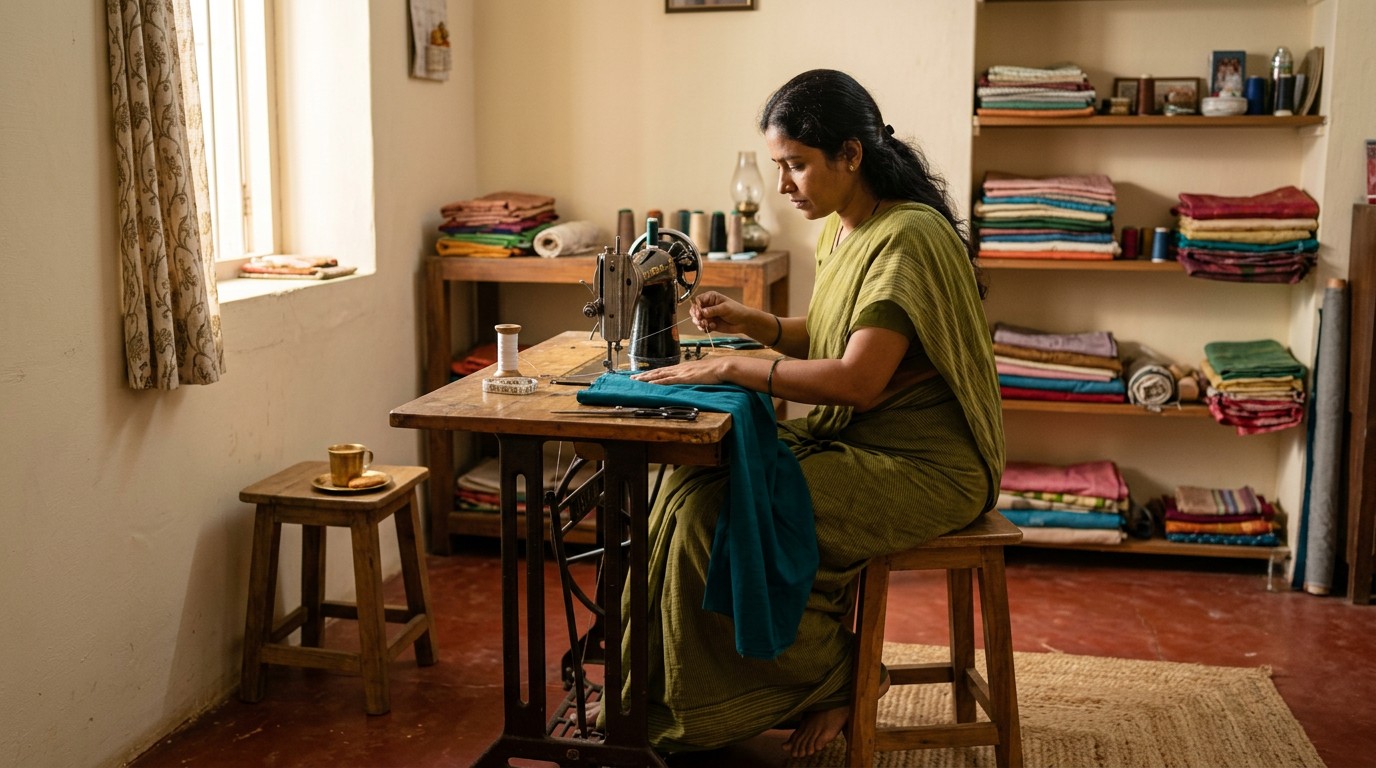
Real sewing jobs from home in India pay per piece and never charge you first. Kurti job work is listed at Rs 25 to Rs 150 a piece, and home workers keep less. An offer wanting a registration fee, machine deposit or kit price before work arrives matches police cases from Nashik and Nagpur, not a job.
Listen to this article, about 13 minutes. A synthetic voice reads the article and announces each section title as it begins; tables are read row by row and the questions at the end are left out.
Recorded 13 November 2026 from the article as published that day. Press a chapter to jump there; the highlighted line is what is playing. A play button sits beside every section heading, and once you scroll past this player a bar at the bottom of the screen keeps the controls in reach. Tap or click any sentence to hear the reading start from there.
On this page: listed kurti job work rates set against four dated police and fact check records of sewing fee offers, and what PM Vishwakarma gives a tailor, checked on 13 November 2026.
Think you already know this? Five questions, one minute.
Every answer is on this page. Answer from what you know now; the page fills in the rest.
-
1. Who sets the Rs 25 to Rs 150 per piece rates in the table?
They are seller asking prices on IndiaMART, so a home stitcher working for such a unit earns less than these figures. Read the section
-
2. What did the Nashik women report being promised along with sewing machines?
The Free Press Journal report of May 2026 says the promise borrowed the scheme’s real Rs 15,000 toolkit figure. Read the section
-
3. What did fact checks find about the viral free silai machine yojana?
The DFRAC fact check found no central government announcement; some states run their own schemes with official notifications. Read the section
-
4. How does a tailor register for PM Vishwakarma?
The PIB note of 16 September 2026 says applications go through Common Service Centres only, and the launch release says registration is free. Read the section
-
5. At Rs 25 a piece, how many kurtis does a Rs 5,000 fee take to recover?
5,000 divided by 25 is 200, and Rs 25 is what a Kolkata unit charges its buyers, not what a home stitcher receives. Read the section
Sewing is one of the few home based jobs where the work is real and visible: a machine, a pile of cut fabric, a finished kurti. That is exactly why the fee version of it works so well on people. Nobody believes they will get rich typing captchas, but a free machine plus a government cheque sounds almost reasonable, which is the whole trick. This page sets out what the genuine work pays, what the fee offers looked like in police records, and what the one real central scheme for tailors actually gives.
What do real sewing jobs from home pay per piece?
Real work comes from people who have garments to finish: a job work unit with an export order, a local boutique that is short of hands, a neighbourhood tailor with a wedding season backlog. They pay per piece, after the piece is done and checked. You bring the skill and usually the machine; they bring the fabric.
The listed rates below are what job work units charge their own buyers. A woman stitching at home for such a unit is a step further down the chain, so her rate sits below these figures, sometimes far below. The two worker figures in the table come from a 2023 report and are what individual women said they were paid, not a survey.
| Who quotes the rate | Work | Rate per piece | What it means for a home worker | Source |
|---|---|---|---|---|
| Kolkata job work unit, listed on IndiaMART | Kurti cutting and stitching | Rs 25, before tax | What the unit charges its buyer; the stitcher’s share is lower | IndiaMART listing |
| Surat job work unit, listed on IndiaMART | Kurti stitching | Rs 29 | Same: a seller’s asking price | IndiaMART listing |
| Mumbai embroidery and stitching unit, listed on IndiaMART | Ladies kurti with embroidery, 5 to 10 days | Rs 150, before tax | Designer work with embroidery included, not plain seams | IndiaMART listing |
| Home based garment worker, reported in 2023 | Pasting embellishments on garments | Rs 15 to Rs 25 | What a worker said she was paid | ISignal |
| Home based garment worker, reported in 2023 | Garment piece work | About Rs 2, or Rs 3,000 to Rs 4,000 a month | What a worker said she was paid | ISignal |
Notice the spread. Rs 2 a piece and Rs 150 a piece are both called sewing work. The difference is skill, embroidery, who owns the order and how many middlemen sit between you and the brand. Seedha unit se kaam milta hai toh rate better hota hai; the more hands the order passes through, the thinner your share.

Silai machine ke naam pe fee maangi? What the fee offers look like
The fee offers rarely call themselves a job. They arrive as a training programme, a self help group, a government scheme or a franchise, and the money is described as a registration charge, a refundable deposit or the cost of a kit. The four records below are the clearest dated ones we could find, and they share a shape: money moves first, the machine or cheque is always coming next week.
| Record | What was promised | What people paid | Refund or buy back | What happened | Source |
|---|---|---|---|---|---|
| Lasalgaon, Nashik district, reported 14 May 2026 | Free tailoring training, sewing machines and a Rs 15,000 cheque said to come from the Vishwakarma scheme | Rs 3,500 to Rs 10,000 each, from 64 women, about Rs 2.5 lakh in all, partly by PhonePe | Receipts issued in the organisation’s name | No machines or cheques; case under BNS sections 316(2), 318(4) and 3(5) | Free Press Journal |
| Sitabuldi, Nagpur, reported 27 May 2024 | An advert for free sewing machines for underprivileged women | Women recruited to collect scheme forms carrying fees of Rs 100 to Rs 9,500 each, over Rs 35 lakh in total | None; the office shut | Case under IPC sections 420, 406 and 34 | Nagpur Today |
| Bhandup, Mumbai, reported 28 January 2026 | Higher than market pay for zari and embroidery work on export garments | Nothing paid in; the artisans did Rs 4.46 crore of work | Rs 2.11 crore of it allegedly never paid | Case under IPC sections 406, 409, 420 and 34; investigation ongoing | Free Press Journal |
| Viral “free silai machine yojana” messages | A free machine from the central government, sometimes with cash | Varies; the message usually leads to a form | Not applicable | Fact checks found no such central scheme announced | DFRAC fact check |
The Nashik case is the one to study. The promised Rs 15,000 cheque borrows the exact toolkit figure from the real PM Vishwakarma scheme, which is free to join. A scam that quotes a genuine government number is more convincing than one that invents a number, and it costs the scammer nothing to look it up.
The Bhandup case is a different warning. Those artisans did the work and, police allege, were not paid for half of it. Genuine work carries a payment risk too, which is why the safer job work arrangements pay per batch rather than at the end of a long order. For the wider family of these offers, our page on packing jobs from home and what people who paid report follows the same deposit pattern with pens and incense sticks instead of kurtis.

What do police cases and complaints actually show?
We read seven records for this section: three police case reports (Nashik, Nagpur, Bhandup), one fact check on the free machine messages, and three consumer complaints about registration fee home jobs on Voxya and similar boards. We also searched Reddit twice and found no Indian sewing specific account worth citing. These are allegations and reported experience, not court findings.
- In Lasalgaon, Nashik, women report paying between Rs 3,500 and Rs 10,000 each, by app transfer and in cash collected in the village, for machines and cheques that never came. Police booked three people in May 2026 and said they were checking similar cases in Niphad, Sinnar and Yeola (Free Press Journal, May 2026).
- In Nagpur, the free sewing machine advert was only the door. Women who answered it were turned into form collectors and the fees they gathered, over Rs 35 lakh, went with the operator when the office shut (Nagpur Today, May 2024).
- In Bhandup, ten embroidery artisans say they were promised above market pay and international exposure, did Rs 4.46 crore of work, and received Rs 2.34 crore (Free Press Journal, January 2026).
- On complaint boards, the repeated story is a registration fee described as refundable, followed by work that is rejected and a refund that never arrives; one complainant on Voxya says exactly this (Voxya complaint).
Where the records agree with the official line: no genuine employer or government scheme in these cases asked for money before work, and every loss began with a payment. Where they add something the guidance skips: the bait is often a real scheme’s name and number, and the person collecting the money is often someone local, which makes it feel safe. Gaon mein aake paise le gaye, isliye bharosa ho gaya, is the pattern in Nashik.
Is the government giving free sewing machines to women?
Not through any central scheme. A DFRAC fact check of the viral free silai machine yojana posts found no announcement by the central government, and the claim keeps returning with a new year attached. States do run their own schemes from time to time. Telangana’s minorities finance corporation, for example, announced 10,490 machines at about Rs 7,830 each under Indiramma Mahila Shakti, and activists complained that applicants were spending Rs 800 to Rs 1,000 on documents and filing (Telangana Today, December 2024).
A real state scheme has an official notification and an office. It is not sold on WhatsApp by a stranger collecting deposits.

What does PM Vishwakarma actually give a tailor?
Tailor (Darzi) is one of the 18 trades on the PM Vishwakarma portal, run by the MSME ministry. It is the one central scheme with real money for people who already sew. It is aimed at self employed artisans aged 18 or over, one member per family, and nobody in government service or their family is eligible.
| PM Vishwakarma component | For a registered tailor (Darzi) | Source |
|---|---|---|
| Registration | Free, through a Common Service Centre only | PIB launch release; PIB note, 16 Sep 2026 |
| Basic training | 5 to 7 days, Rs 500 a day stipend | PIB note |
| Toolkit | Up to Rs 15,000 | PIB note |
| First loan | Up to Rs 1 lakh, 18 months, 5% interest, no collateral | PM Vishwakarma portal |
| Second loan | Up to Rs 2 lakh, 30 months, 5% interest, after repaying the first | PM Vishwakarma portal |
| Digital incentive | Rs 1 per digital transaction, up to 100 a month | PIB note |
Two cautions from reading the official pages on the same day. First, the PIB note of 16 September 2026 says the 30 lakh registration target has already been reached, so whether your district is still registering new applicants is something to confirm at a Common Service Centre, not assume. Second, the sources disagree on past loans: the portal says anyone who took a PMEGP, PM SVANidhi or Mudra loan in the previous five years is out, while the PIB note says Mudra and SVANidhi borrowers who have fully repaid are eligible. Ask the CSC which rule they are applying before you count on it.
Progress so far, as of 15 September 2026 in the same note: over 24.37 lakh artisans trained, more than 18.16 lakh toolkits given and about 6.19 lakh loans worth roughly Rs 5,316 crore sanctioned, across all 18 trades. No tailor specific figure was published.
How many pieces would you have to stitch to earn back a Rs 5,000 fee?
Take a Rs 5,000 fee, which sits inside the Rs 3,500 to Rs 10,000 range the Nashik women report paying. At the Rs 25 a piece a Kolkata unit charges its buyers, that is 200 kurtis just to get back to zero, and that is the unit’s rate, not yours. At the Rs 2 a piece one home worker described in 2023, it is 2,500 pieces. At Rs 15 for embellishment work, about 334.
Which is the whole point of the fee model: the fee is the product. If the company made its money from your stitching, it would not need your Rs 5,000 first. Our part time job scam pehchan guide runs the same arithmetic on other deposit jobs, and the Meesho work from home page covers the reseller version, where you sell clothes instead of sewing them.
What should you check before paying for a sewing kit or machine?
The checklist further down this page has the specific questions. The short version, written straight: a genuine job work unit or boutique pays you for finished pieces and does not take a deposit, a registration fee or a kit price. A government scheme has an official portal and an office, and PM Vishwakarma registration is free at a CSC. Do not share Aadhaar, bank or OTP details with anyone who contacts you about a scheme.
If someone only tried it and you paid nothing, report the call, SMS or WhatsApp message on Chakshu on Sanchar Saathi. The telecom department told Parliament that the category covering online job, lottery, gift and loan offers drew 58,560 reports in 2025, up from 23,634 in 2024. If money has already gone, call 1930 at once and file on cybercrime.gov.in; our guide to reporting online fraud in India walks through both. If you are new to home work generally, our list of who hires freshers and who charges them is the place to start.
This page is general information, not financial or legal advice, and it was checked against the linked sources on 13 November 2026.
Before paying for any sewing kit, machine or registration
Tick each one you have confirmed. Any box you cannot tick is a reason to wait, not to pay.
Ticks are saved on this device only. This list does not judge any particular offer.
Frequently asked questions
Can I get sewing work from home without paying anything?
Yes. Genuine job work from garment units, boutiques and local tailors is paid per finished piece, and the giver supplies the fabric. What you usually need is your own machine and enough skill to pass their check.
Silai ka kaam ghar baithe milta hai kya, bina fee ke?
Haan, milta hai, mostly through local boutiques, tailors and job work units near you. Any offer that asks for a fee before giving cloth matches the pattern in the Nashik and Nagpur police cases.
Is the free silai machine yojana real?
A fact check found no central scheme by that name was announced. Some states run their own machine schemes with official notifications, so check your state department’s website rather than a forwarded message.
Does PM Vishwakarma give free sewing machines?
It gives a toolkit incentive of up to Rs 15,000, a Rs 500 a day stipend during training and loans at 5% to registered tailors. Registration is free and happens only at a Common Service Centre.
Kit wale ne buy back ka promise kiya hai, bharosa karein?
A buy back promise is only as good as the company that makes it, and in the records we read the company vanished first. If the deal needs your money before their order, treat it as a fee, not a job.
Where do I complain if I already paid for a sewing job kit?
Call 1930 as soon as possible and file on cybercrime.gov.in with your payment screenshots and chats. You can also go to your local police station, as the Nashik women did.
Finished the page? The same five questions from the top, to see what stuck.
Platform rules and rates change without notice. This page was verified in November 2026 and is rechecked on the Sunday refresh. If you hit something different, tell us in the comments and we will update it.

Leave a Reply