
Payoneer India works for freelancers, but the cost depends on how your client pays. On a 1,000 dollar invoice paid into a Payoneer USD receiving account, expect about 30 dollars gone at the 2 percent withdrawal rate Payoneer quotes, and up to about 50 dollars at the 4 percent ceiling on its India pricing page. The FIRA is free.
Listen to this article, about 11 minutes. A synthetic voice reads the article and announces each section title as it begins; tables are read row by row and the questions at the end are left out.
Recorded 28 September 2026 from the article as published that day. Press a chapter to jump there; the highlighted line is what is playing. A play button sits beside every section heading, and once you scroll past this player a bar at the bottom of the screen keeps the controls in reach. Tap or click any sentence to hear the reading start from there.
On this page: a 1,000 dollar invoice costed four ways from Payoneer’s India pricing page on 28 September 2026, the point where that page and Payoneer’s own withdrawal fee guide disagree, and what the January 2026 RBI licence does and does not change.
Think you already know this? Five questions, one minute.
Every answer is on this page. Answer from what you know now; the page fills in the rest.
-
1. When does Payoneer charge its 29.95 dollar annual account fee?
Payoneer’s pricing page says the fee applies only if the account receives less than 6,000 dollars or equivalent in any 12 consecutive months. Read the section
-
2. What range does Payoneer’s India pricing page give for withdrawing to a local bank?
The India pricing page lists 1 to 4 percent, while the withdrawal fee guide updated on 23 September 2026 says up to 2 percent. Read the section
-
3. Which way of being paid costs the most on a 1,000 dollar invoice, using Payoneer’s published fees?
A card payment carries 2.90 percent plus 0.49 dollars on the way in, per the India pricing page, so it totals about 48.90 dollars at a 2 percent withdrawal, against 20 dollars from a Payoneer balance. Read the section
-
4. What does Payoneer charge for a Digital FIRA?
Payoneer’s Digital FIRA FAQ says the FIRA is free and appears within 1 to 3 business days of a payment. Read the section
-
5. What did Payoneer India receive from the RBI in January 2026?
Payoneer announced on 22 January 2026 in-principle authorisation as a PA-CB for inward and outward transactions, a step before final authorisation. Read the section
Most pages ranking for Payoneer in India are written by Payoneer or by a company selling a rival remittance product, and both have a number they would like you to remember. So here is the arithmetic done from Payoneer’s own published fees, checked on 28 September 2026, including the part where Payoneer’s own pages do not agree with each other.
What does Payoneer charge an Indian freelancer today?
There are two fees on almost every payment: one when the money arrives in your Payoneer balance, and one when it leaves for your Indian bank as rupees. Here is what Payoneer publishes for each, as read on 28 September 2026.
| Fee | What Payoneer publishes | Where it says so |
|---|---|---|
| Client pays from their own Payoneer balance | Free to receive | India pricing page |
| Client pays into your USD receiving account | 1 percent, minimum 1 dollar | Global pricing page |
| Client pays by card through a payment request | 2.90 percent plus 0.49 dollars | India pricing page |
| Client pays by US ACH bank debit | 1 percent | India pricing page |
| Marketplace payouts such as Upwork or Fiverr | Set by the marketplace | India pricing page |
| Withdrawal to your Indian bank in rupees | Up to 2 percent, or 1 to 4 percent | Withdrawal fee guide and India pricing page |
| Annual account fee | 29.95 dollars, only if you receive under 6,000 dollars in 12 consecutive months | Global pricing page |
| Digital FIRA | Free, per payment | Payoneer help centre |
The annual fee catches people who use Payoneer for one small platform. Receive 5,000 dollars across a year and you still pay 29.95 dollars; receive 6,000 and it goes away. Worth knowing before you choose Payoneer as the payout route for a micro task site.
Why do Payoneer’s own pages disagree on the withdrawal fee?
This is the number that matters most, and it is the one we could not pin to a single figure. Payoneer’s guide to how it calculates withdrawal fees, last modified on 23 September 2026, says a withdrawal to a local bank in a different currency costs up to 2 percent. Its India pricing page lists the withdrawal to a local bank as 1 to 4 percent, adding that the exact fee depends on region and transaction volume. The global pricing page gives 1.2 to 4 percent for a withdrawal in your local currency.
Both statements come from Payoneer, on the same day, and they are not the same promise. We have not found a published schedule that says which Indian accounts pay what inside that range, so the honest answer is: the rate you see on your own withdrawal confirmation is the rate that applies to you. Screenshot it. Comparing a few of them against the mid market rate for the same hour is the only way to know your real spread.
What does a 1,000 dollar invoice actually cost through Payoneer?
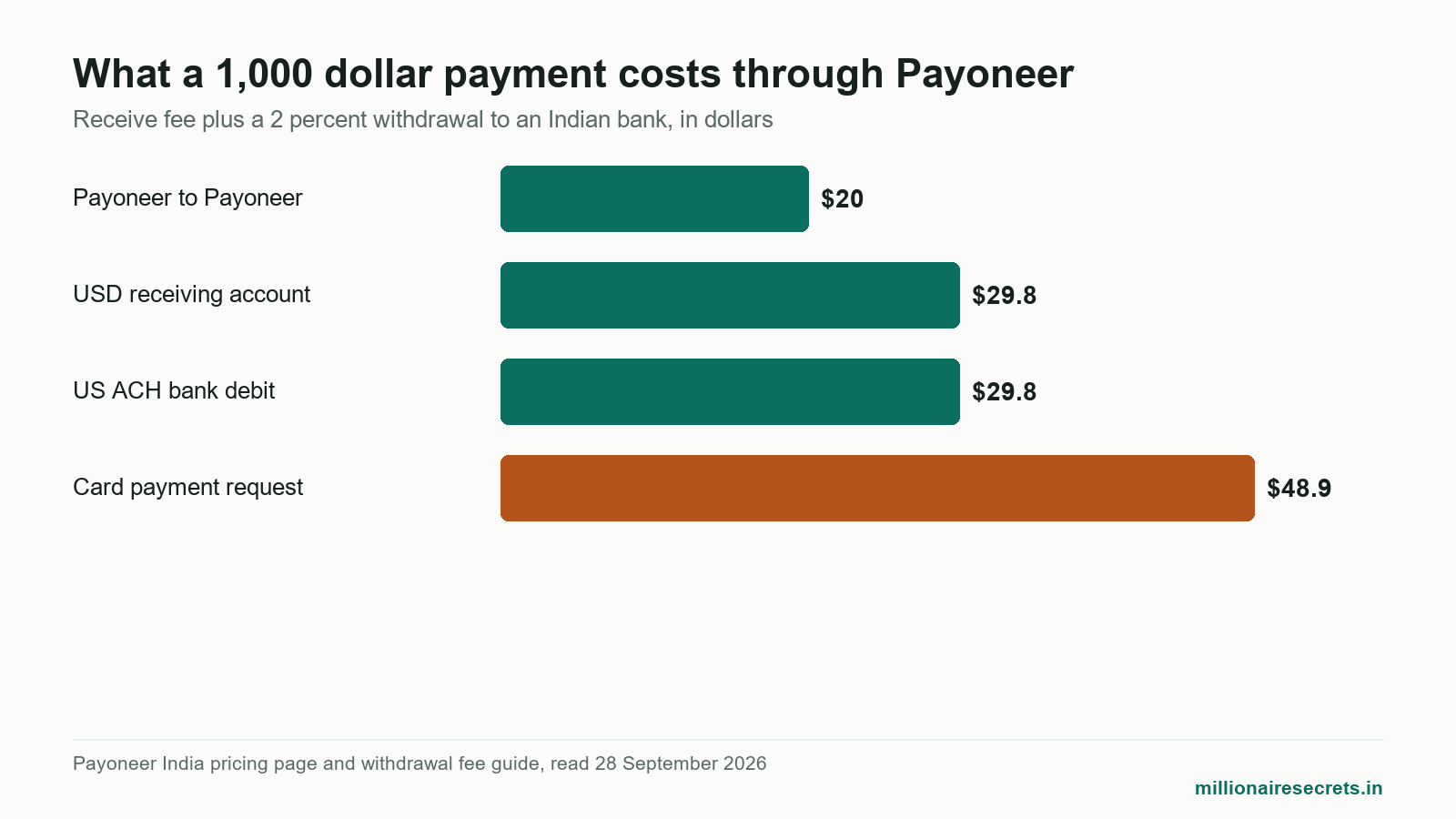
Here is the worked version, using only the fees in the table above. Inputs: a 1,000 dollar payment, the receive fee for each route, then the withdrawal fee applied to what is left. No exchange rate is assumed, because the fee is what you can check; the rupee figure depends on the rate at the minute of withdrawal.
| How the client pays | Receive fee | Withdrawal at 2 percent | Total at 2 percent | Total at 4 percent |
|---|---|---|---|---|
| From their Payoneer balance | 0.00 | 20.00 | 20.00 (2.0%) | 40.00 (4.0%) |
| Into your USD receiving account | 10.00 | 19.80 | 29.80 (3.0%) | 49.60 (5.0%) |
| US ACH bank debit | 10.00 | 19.80 | 29.80 (3.0%) | 49.60 (5.0%) |
| Card, via a payment request | 29.49 | 19.41 | 48.90 (4.9%) | 68.31 (6.8%) |
Two things jump out. First, how your client pays moves the cost more than anything you do: a card payment costs nearly two and a half times a Payoneer to Payoneer transfer. If a client already has Payoneer, ask them to pay from their balance. Second, at the 4 percent ceiling, a direct invoice costs about 5 percent, which is a very different conversation from the 2 to 3 percent most comparison posts quote, including our own PayPal, Payoneer and Wise comparison, which we are rechecking against these pages.

Payoneer fee calculator
Enter a payment in dollars, choose how the client pays, and set the withdrawal rate your own confirmation shows. The calculator applies Payoneer’s published fees and shows every step. It is arithmetic on published rates, not a quote.
Payoneer’s withdrawal fee guide says up to 2 percent; its India pricing page says 1 to 4 percent. A marketplace’s own withdrawal fee is separate. The rupee amount depends on the exchange rate at the minute of withdrawal.
Payoneer se paisa bank mein kitne din mein aata hai?
Payoneer’s India pricing page says that for customers based in India, payments received are automatically withdrawn to your local Indian bank account within 48 hours. You do not choose when to convert; the money does not sit in dollars waiting for a better rate. Wise works the same way in India: its help page for Indian businesses says USD account details cannot be used to hold a balance, for regulatory reasons, and the rupees reach your bank in 1 to 2 days.
So the old advice to hold dollars and convert when the rupee weakens does not apply to an Indian Payoneer account. Anyone selling you a trick to time it is selling something else.
How do you get a FIRA from Payoneer, and does it cost anything?
Payoneer’s Digital FIRA FAQ says the FIRA is free, generated by its partner Authorized Dealer bank in India, and available for download within 1 to 3 business days of a payment, on a best effort basis. It sits under Manage, then Reports and statements. Past or missing FIRAs go through customer support.
That free FIRA is Payoneer’s clearest edge over Wise for anyone paid many small amounts. Wise charges the equivalent of 2 dollars per transfer for its e-FIRC, per its help centre, so twenty small payments a month is 40 dollars in certificates before GST. What a FIRA is for, and why your bank and your CA ask for it, is in our FIRA and eFIRA guide.
One setting deserves two minutes today: your purpose code. Payoneer tags it to every payment you receive, and it is what tells your bank the money is an export of services. It lives under Settings, Profile settings, Additional details. A wrong code is a boring problem that becomes an expensive one at filing time, and it matters for the GST LUT route too.

What does the RBI PA-CB licence change for Payoneer users in India?
On 22 January 2026 Payoneer India Pvt Ltd announced in-principle authorisation from the Reserve Bank of India to operate as a Payment Aggregator Cross Border for inward and outward transactions. Payoneer says Indian businesses will get streamlined onboarding and KYC, and access to more of its products, including accounts payable.
Three things the announcement does not say. In-principle is not final authorisation, and as of 28 September 2026 we found no announcement of the final licence. The rules behind it come from the RBI circular on PA-CB of 31 October 2023, which caps the value per unit of goods or services at Rs 25 lakh and requires customer due diligence of each merchant under the RBI KYC direction. For a freelancer that likely means the KYC checks become the regulator’s requirement rather than Payoneer’s preference. And nothing in either document changes the fees in the tables above.
| Payoneer | Wise | |
|---|---|---|
| Receive from a client | Free to 2.90% plus 0.49 dollars, by route | Varies by currency and method |
| Conversion to rupees | Up to 2%, or 1 to 4%, per Payoneer’s own pages | Shown in Wise’s calculator per transfer |
| Hold dollars in India | No, auto withdrawn within 48 hours | No, per Wise’s help page |
| FIRA or e-FIRC | Free, per payment | Equivalent of 2 dollars per transfer |
| Annual fee | 29.95 dollars under 6,000 dollars a year | Not checked for this page |
| RBI status in India | PA-CB in-principle, January 2026 | Not checked for this page |
What should you check before trusting Payoneer with your income?
Of the 20 most recent one star reviews we read on a Payoneer account review page, from many countries, most were about verification holds and frozen balances, and that risk bites hardest when a platform pays you through Payoneer alone. We looked for dated accounts from Indian freelancers and found too few recent, specific ones to report as a pattern. What we can report is that Payoneer’s Trustpilot page showed, on 28 September 2026, a notice that its rating is unavailable because of a breach of guidelines and that fake reviews had been removed. Treat the star count there with caution in both directions.
- Keep your PAN, address proof and bank statement current before a large payment lands, since a verification request freezes withdrawals until it clears.
- Match the name on Payoneer, your bank account and your PAN exactly.
- Download each FIRA as it arrives rather than at filing time.
- Never share your Payoneer login or OTP with anyone offering to speed up verification. Payoneer support does not need your password.
If a platform pays you through Payoneer, the platform side is covered in our Mindrift India review and Fiverr for Indian sellers. For the tax side, section 44ADA is where most freelancers land. Every route for getting foreign money into India is compared in how to receive foreign payments in India.
This page is general information from published fee schedules, not financial or tax advice. Fees change without notice; your withdrawal confirmation shows the rate that applies to you.
Before a large payment lands in Payoneer
Tick these off so a verification request does not freeze the money when it arrives.
Payoneer support does not need your password or OTP to finish a verification.
Frequently asked questions
Is Payoneer legal to use in India?
Yes. Payoneer India Pvt Ltd received in-principle authorisation from the RBI as a Payment Aggregator Cross Border on 22 January 2026, and payments reach your bank through its partner Authorized Dealer bank, which issues your FIRA.
Payoneer ka annual fee kitna hai?
29.95 dollars a year, charged only if your account receives less than 6,000 dollars in any 12 consecutive months, per Payoneer’s pricing page. Receive 6,000 dollars or more in that window and it is not charged.
Can I keep dollars in my Payoneer account in India?
No. Payoneer’s India pricing page says payments received by customers based in India are automatically withdrawn to the linked Indian bank account within 48 hours.
Payoneer FIRA kaise download karein?
Sign in, go to Manage, then Reports and statements, and open Digital FIRA. Payoneer says each FIRA is free and appears within 1 to 3 business days of a payment.
Is Payoneer cheaper than Wise in India?
It depends on how you are paid. Payoneer to Payoneer transfers and a free FIRA per payment favour Payoneer for many small marketplace payouts; the comparison for a few large direct invoices depends on the rate each shows you on the day.
Does the RBI licence mean Payoneer fees will change?
Not on anything published so far. The January 2026 announcement talks about onboarding, KYC and new products, and says nothing about fees for freelancers receiving payments.
Finished the page? The same five questions from the top, to see what stuck.
Platform rules and rates change without notice. This page was verified in September 2026 and is rechecked on the Sunday refresh. If you hit something different, tell us in the comments and we will update it.

Leave a Reply